Two ways to move goods without a driver
Imagine a warehouse where cartons must travel from storage to a packing area many times a day. An automated guided vehicle, or AGV, can make that trip by following a planned route. An autonomous mobile robot, or AMR, can make a similar trip while using information about its surroundings to choose a path through the space. Both can reduce the need for people to push carts or drive loads between stations, but neither removes the need to plan the work around them.
The distinction is mainly about navigation, not appearance. Either type of machine might carry totes, tow carts or move under a rack. The useful question is how it knows where to go, what it does when its path is blocked and how much the warehouse must change to accommodate it.
How guidance and navigation differ
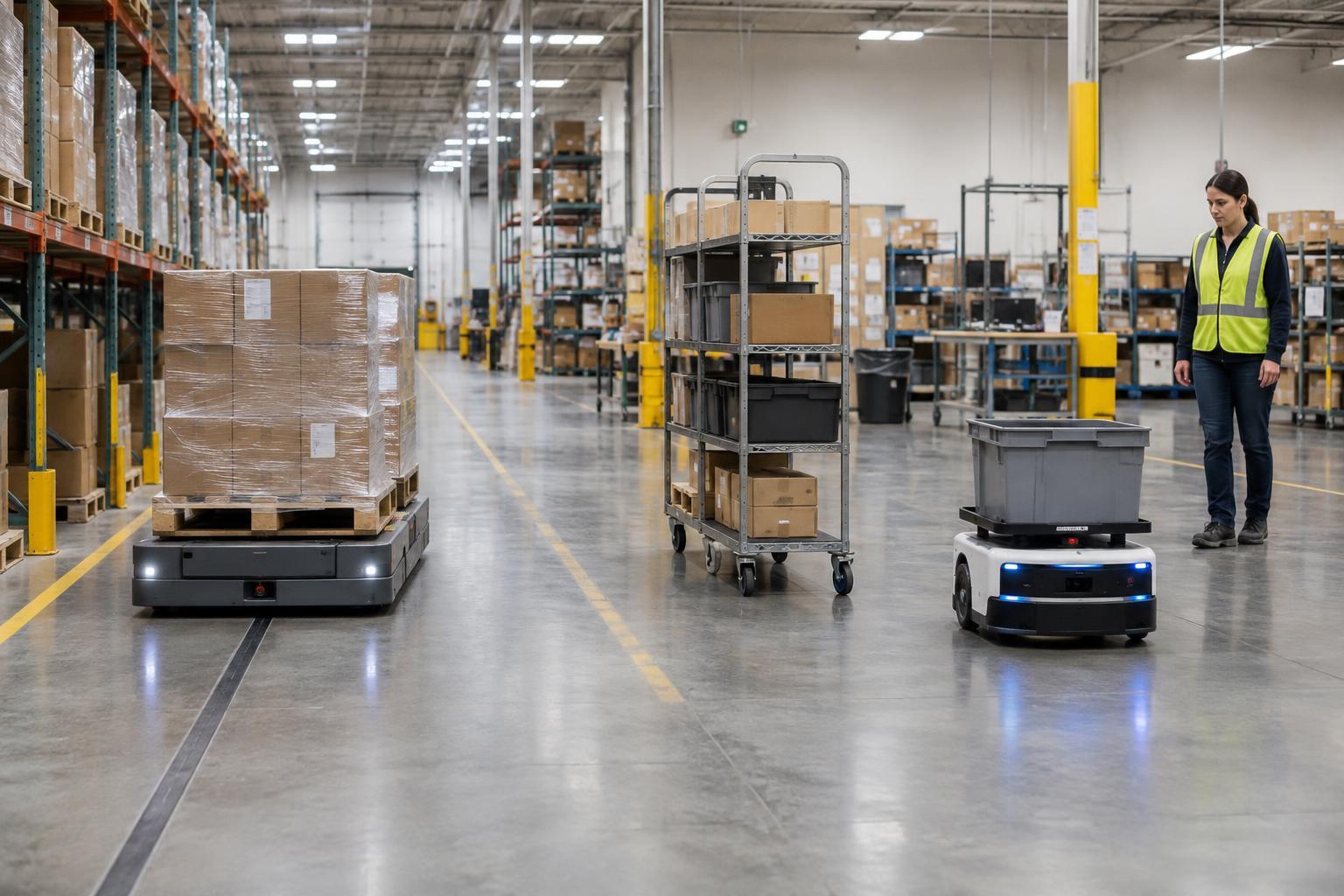
Traditional AGVs follow routes defined in advance. A facility might use floor tape, embedded guidance or fixed reference points to help a vehicle stay on course. This makes movement predictable: staff can know where vehicles are expected to travel, and repeated trips can be organized around those paths. Changing a route, however, may require changes to the guidance system, the facility layout or the vehicle configuration.
AMRs typically use sensors and a map to locate themselves and navigate between destinations. If an aisle is blocked, an AMR may be able to find another permitted route rather than wait for the original path to clear. That ability depends on the available space, the quality of its map and the rules set for its operation. An AMR cannot invent a safe passage through a crowded or physically closed aisle.
These labels describe broad approaches rather than two perfectly separate classes. Some AGVs use sophisticated sensing, while some AMRs operate within tightly defined zones and routes. When comparing products, it is more helpful to ask what a particular machine can do in the intended warehouse than to rely on its label alone.
Where each approach fits
An AGV can be a good match for a stable, repetitive movement. For example, a warehouse might regularly transfer loaded carts between receiving and a storage area along a clear corridor. If the route and handoff points rarely change, a fixed path may be straightforward to manage. Predictability can also make it easier to arrange other activities around vehicle traffic.
An AMR may be more useful where destinations change throughout the day. A robot delivering picking totes to several packing stations could receive new assignments and select among available routes. That flexibility can be valuable when shelving, workstations or demand patterns change, although it does not guarantee faster deliveries. A longer alternative path, a congested aisle or a slow handoff can still delay the job.
Warehouses can also use both approaches. One system might handle a regular, high-volume transfer while another serves changing destinations. The choice should reflect the actual trips being made: their frequency, load size, pickup and drop-off requirements, available space and likely changes to the layout.
What automation must share with people
Navigation is only part of warehouse operation. Vehicles may encounter pedestrians, manual forklifts, loose packaging and carts left in aisles. Sensors and operating rules can help a machine detect hazards and slow or stop, but teams still need clear traffic plans, suitable handoff areas and a way to respond when a vehicle cannot continue. A robot that stops safely in a busy crossing has avoided one problem but may create a queue that staff must resolve.
The surrounding workflow matters just as much. Goods must be ready when a vehicle arrives, loads must be secure, and someone or something must complete the pickup and drop-off. Charging, maintenance and software connections to warehouse systems also affect how useful a fleet will be. These needs apply to AGVs and AMRs, even if the details differ.
Choosing by workflow, not by label
A practical comparison starts with a map of recurring movements and the delays people experience today. Identify which trips are predictable, where routes are frequently blocked and how often destinations move. Then consider what changes the building can support, from marked travel lanes to charging locations. A small trial on a representative route can reveal problems that are easy to miss on a floor plan, such as awkward load handoffs or congestion at shift changes.
AGVs offer a structured way to automate repeatable routes; AMRs offer more room to adapt within a changing space. Neither is automatically the better warehouse robot. The strongest fit is the one that moves the right loads reliably while leaving people enough space and clear procedures to do their work.