What makes a bus on demand?
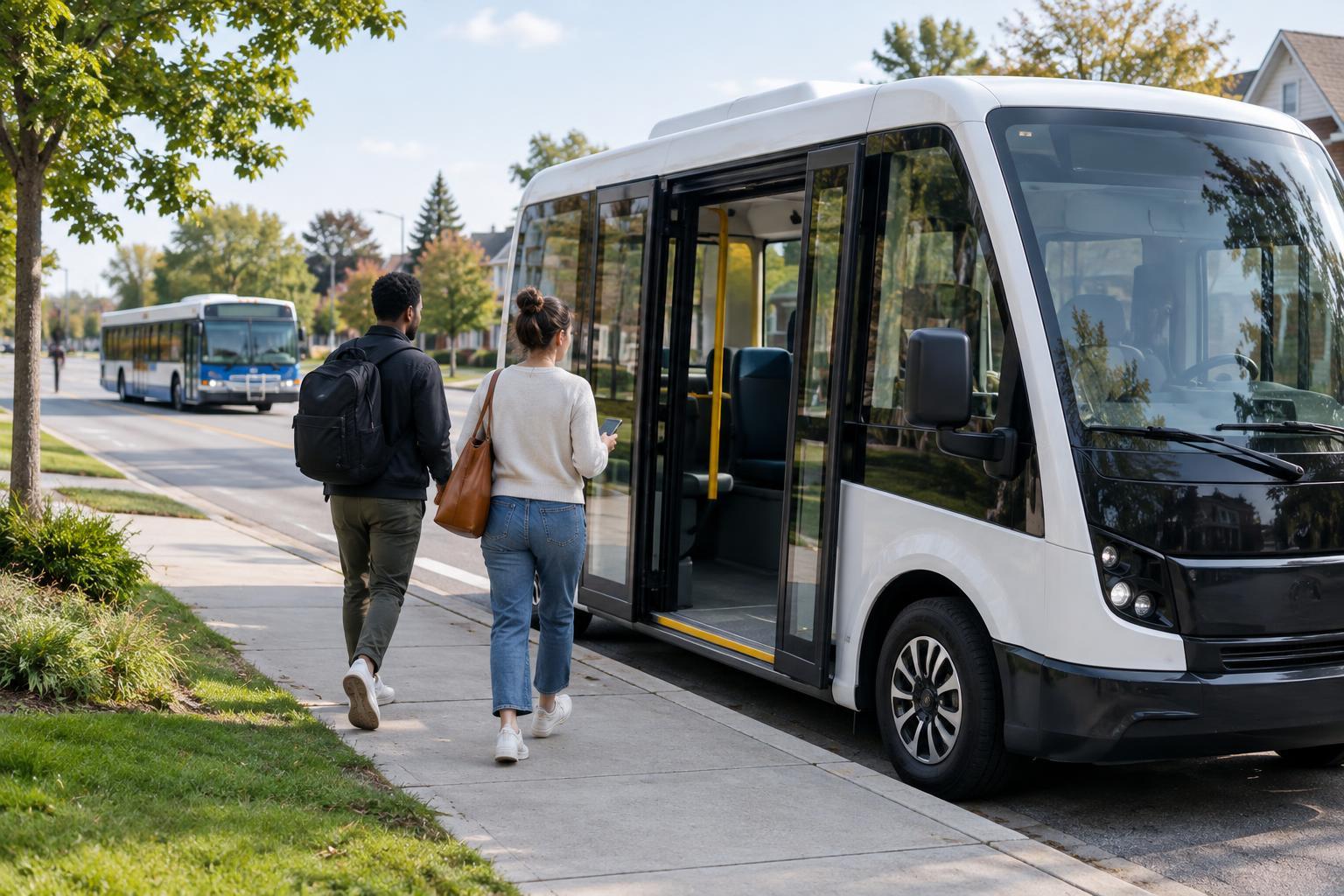
A conventional bus follows a published route and timetable whether every stop has a waiting passenger or not. An on-demand bus operates within a defined area but adjusts some part of its service in response to trip requests. A rider might book a pickup through an app or by phone, then receive a pickup time and location. Depending on the system, the vehicle may stop at a regular bus stop, a designated meeting point or another permitted location.
This is shared transport, not a private car ride. The operator may group several passengers whose trips are going in broadly compatible directions. That can mean a short walk to a pickup point, a wait before departure or a detour to collect someone else. Some services allow immediate requests; others require advance booking. The name alone does not tell a rider which rules apply.
Where flexibility can be useful
Flexible routing can help in places where homes and destinations are spread out and a fixed bus would travel long stretches with few passengers. It may also serve as a connection to a train station or a frequent bus route, particularly when the final part of a journey is too far to walk comfortably. In these situations, a defined service area gives riders more possible pickup points without requiring a bus to visit every street on every trip.
A practical test is to map a real journey rather than admire the routing technology. Can the rider arrive at the station before the train leaves? Is there a way to book the return trip after an appointment whose end time is uncertain? Can someone without a smartphone use the service? Exploring questions like these is a useful way to build transport-planning skills; for more ideas about learning practical skills, browse Nauka i umiejętności · Pracownia Codzienności.
On-demand service can also complement a fixed route during quieter periods. That does not mean replacing a frequent bus is automatically an improvement. Where many people travel along the same corridor, a bus with predictable stops and departures can carry passengers efficiently without asking each person to make a reservation.
The trade-offs riders actually notice
Flexibility creates uncertainty unless the booking system makes its limits clear. A requested pickup time may be an estimate or a time window, and a shared vehicle’s path may change as other requests arrive. Riders making a tight connection need to know whether the service guarantees arrival by a certain time or merely aims for it. A map showing the service boundary is just as important: a destination a few streets outside it may not be eligible.
Accessibility depends on more than the vehicle. The booking method should be usable by people with different needs, and pickup points should offer a safe, manageable route to the bus. Riders may also need clear information about wheelchair space, assistance, fares and what happens if a vehicle cannot reach a requested location. A short walk that looks reasonable on a map can be difficult beside a road without a suitable crossing.
Small design choices can make the service easier to understand. A clear sign at a meeting point, a booking confirmation that names the correct side of the street, and instructions for missed pickups all reduce guesswork. Sketching a sample booking screen or pickup sign is one way to notice confusing details; for other hands-on creative activities, browse Twórcze hobby · Pracownia Codzienności.
How to judge a service before depending on it
Start with a trip you might actually take and check the operating hours, booking window, fare and pickup rules. Compare the complete journey with a fixed bus, including the walk to the meeting point, expected wait and any transfer. If punctual arrival matters, leave room for a changing pickup time and ask how the operator handles missed connections. Trying a low-stakes journey first can reveal details that a service description does not make obvious.
The underlying idea is established: transport operators can take reservations and combine compatible trips in a shared vehicle. Software may make that coordination easier, but it cannot remove traffic, limited vehicle capacity or competing requests. Future systems might coordinate more smoothly with trains or other buses; that is a possibility, not a feature to assume exists. For now, the most useful on-demand service is one whose rules are clear enough for riders to plan around.