Start with the object, not the robot hand
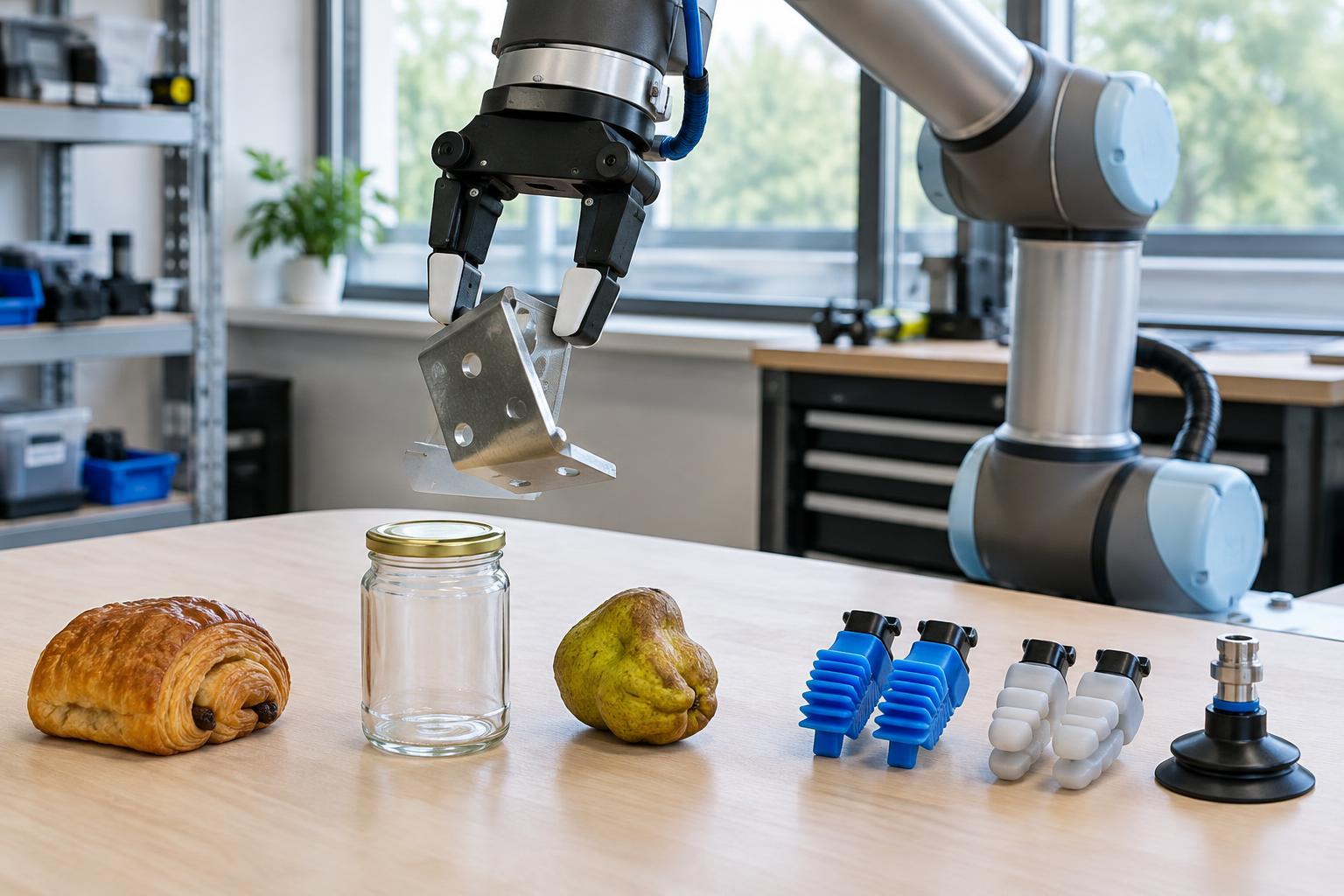
A robot gripper is the part of a robot that makes contact with an object and holds it while the robot moves. Choosing one begins with a deceptively simple question: what exactly must it pick up? A rigid metal bracket, a smooth glass jar and a soft bread roll all ask for different kinds of contact. Even two objects of the same shape may behave differently if one is slippery and the other has a rough surface.
Make a short list of the objects’ sizes, weights, shapes and materials. Note whether they arrive in a fixed orientation or in a jumble, and where the robot can safely touch them. A gripper must also keep its hold when the robot accelerates, turns or stops. The goal is not merely to lift an object once, but to handle the full range of objects in the task without dropping, marking or crushing them.
Fingers suit edges and varied shapes
Mechanical grippers use two or more fingers to close around an object or press against its sides. A two-finger gripper can be a straightforward choice for boxes, blocks and parts with accessible parallel faces. Finger pads made from a compliant material can help spread pressure and improve contact on slightly uneven surfaces. For a heavy or slippery object, though, a secure hold may require more grip force than a delicate surface can tolerate.
Shape matters as much as force. Narrow fingers may reach between closely packed parts, while shaped fingertips can locate a particular component more reliably. Grippers with fingers that adjust to an object’s outline can accommodate a wider mix of shapes, but they still need a suitable place to make contact. If an item changes shape when squeezed, test how much pressure it can accept before assuming a finger grip will work.
Vacuum and magnets depend on the material
Vacuum grippers use suction cups connected to a vacuum source. They are useful when an object has an accessible surface on which a cup can form a seal, such as a smooth panel or a closed carton. They can pick from above without needing room at the sides. A rough, porous or highly curved surface may prevent a reliable seal, however. Flexible packaging can present another challenge if the cup pulls up the packaging rather than supporting the item inside.
Magnetic grippers offer another way to pick up some metal objects without closing fingers around them. They require a material that responds to the magnet; being metallic alone is not enough. They can be convenient for suitable steel parts, especially when side access is limited. Designers must also consider how the part will be released and whether nearby objects might be attracted. Neither suction nor magnetism is a shortcut around checking the actual material and surface.
Delicate and irregular objects call for a gentler approach
Soft grippers use compliant contact surfaces or flexible fingers to conform to an object. This can help when handling produce, baked goods or other items that are easily bruised or irregularly shaped. A larger contact area can distribute the gripping force, although softness alone does not guarantee gentle handling. The gripper still needs enough support to keep the item from slipping during a move.
For very mixed objects, a team might use interchangeable tools rather than asking one gripper to do everything. One tool could lift flat lids by suction, while another holds textured containers with fingers. More experimental grippers aim to adapt to a broad assortment of unfamiliar objects, but a demonstration with a few successful picks does not establish that a tool will handle every variation in a busy setting. Today’s practical choice is usually tied to a defined set of objects and movements.
Test the whole pick-and-place task
A useful trial includes more than the ideal sample placed neatly on a table. Test the smallest and largest objects, ordinary surface variations and awkward starting positions. Watch what happens during lifting, turning, travel and release. Does the object slide within the fingers, peel away from a suction cup or land in the wrong orientation? Repeated trials can expose problems that a single successful lift hides.
Consider the workspace as well as the object. A wide gripper may hold an item securely yet collide with its neighbors. A suction cup may reach into a bin easily but have no suitable surface to seal against. Sensors can help confirm contact or detect a missed pick, but they cannot compensate for a contact method that does not suit the material. The most dependable gripper is the one that handles the real range of objects in the real space, with an acceptable margin for variation.