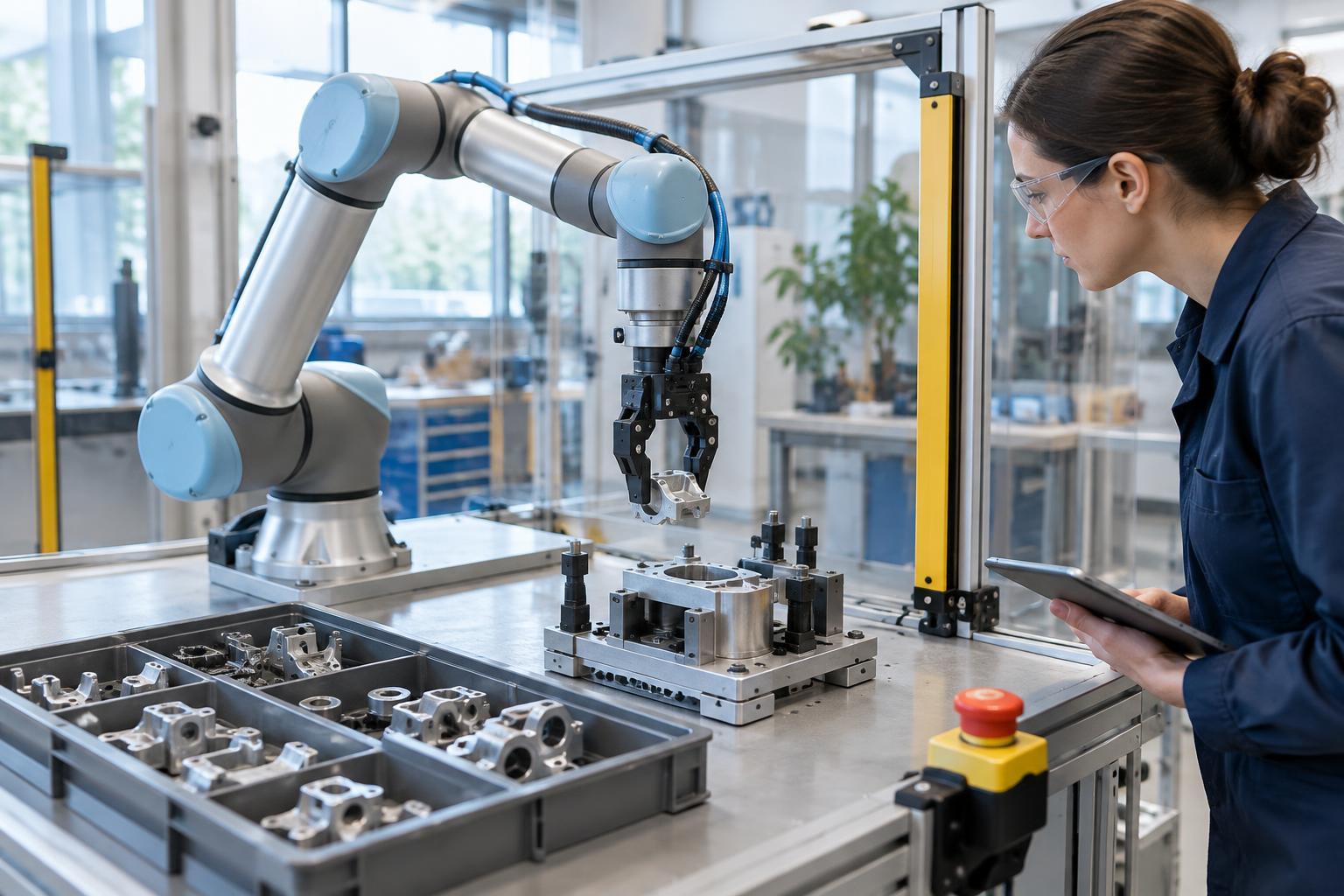
Mistake 1: Assuming every repeated task is predictable
A person might pick up a part hundreds of times a day without noticing how often they adjust their grip. The part may arrive at a slightly different angle, be mixed with similar parts or occasionally have a damaged edge. A robot needs a way to detect and handle those differences. Repetition alone does not make a task straightforward to automate.
Start by describing one complete work cycle: how materials arrive, what the robot must do, what a successful result looks like and what happens when something goes wrong. Note the range of sizes, positions and conditions the robot will encounter. A task with consistently positioned parts may suit a relatively simple setup; loose, varied objects may call for additional sensing, fixturing or a change to the process itself.
It is also worth asking whether the task should stay exactly as it is. A tray that presents parts in a consistent orientation can sometimes simplify automation more than a more sophisticated robot would.
Mistake 2: Shopping by payload and speed alone
Payload and speed are useful specifications, but neither tells the whole story. A robot must reach the workpiece and its destination from a practical mounting position, while carrying the tool as well as the object. It may also need enough room to approach, rotate and withdraw without striking nearby equipment.
Consider a robot packing small boxes. Its rated payload might comfortably exceed the weight of each box, yet the chosen gripper could add weight and make it awkward to reach the far side of a conveyor. Likewise, a fast advertised motion may not translate into a fast completed cycle if the system has to wait for boxes to arrive or for another machine to finish.
Sketch the entire movement, including pickup, placement and clearance around obstacles. Compare possible robots against that movement and the required pace of the wider process. The best fit is not necessarily the machine with the largest number on its specification sheet.
Mistake 3: Treating the robot arm as the whole solution
An arm is only one part of a working system. It may need a gripper, suction tool or other end effector; a fixture to hold objects steady; sensors to locate them; and a way to communicate with surrounding equipment. Choosing the arm first and leaving these details until later can expose problems that are difficult to solve with the original choice.
The object itself often determines the tooling. A rigid container may be easy to grip, while a soft package can change shape or slip. A reflective, transparent or irregular item may be harder for some sensing arrangements to locate reliably. Tooling should be considered with representative samples, including the awkward cases rather than only the easiest ones.
Plan for failed attempts, too. If a pickup misses, can the system notice, retry or set the item aside? A robot that performs the ideal motion well but cannot recover from ordinary variation may demand more human attention than expected.
Mistake 4: Assuming a collaborative robot needs no safety planning
Collaborative robots are designed to support certain forms of operation near people, but the label does not make every application safe. The tool, the object being carried, the robot’s movement and the surrounding workspace all matter. A soft-looking arm carrying a sharp or heavy item can present a different risk from the same arm moving empty.
Consider who needs to load materials, clear jams, change tools and work nearby. Then assess the complete setup, not just the robot model. Depending on the application, appropriate measures might include limiting movement, separating work areas or adding protective equipment and controls. Safety planning belongs early in selection because it can affect the layout, cycle time and choice of robot.
Mistake 5: Overlooking the work after installation
A successful demonstration is not the same as dependable daily operation. Parts may change, operators may need to switch products, and equipment will need cleaning, inspection or adjustment. If a robot stops, someone must be able to tell whether the cause is the tool, the sensor, the incoming material or another machine.
Before choosing a system, think through who will operate it, how tasks will be changed and what support will be available when faults occur. A small trial using real objects and realistic handoffs can reveal issues that a polished demonstration misses. Include normal interruptions, imperfect parts and changeovers in that trial.
The aim is not to automate every repetitive task. It is to find a task whose variation, required pace and working environment can be handled by a system people can use and maintain. Starting with that fuller picture makes robot selection a practical design decision rather than a comparison of machines in isolation.