A working prototype is only the beginning
A prototype answers an important question: can this idea work? It may not answer a different one: can people build it repeatedly without unusual tools, delicate adjustments or excessive waste? A designer might spend an afternoon fitting a sensor into a 3D-printed case. If every finished device needs the same careful hand fitting, the design may be hard to produce reliably.
Design for manufacturing and assembly, often shortened to DFMA, means considering how parts will be made and put together while the product is still being designed. Manufacturing concerns the individual parts: their shapes, materials and production methods. Assembly concerns what happens next: how parts are positioned, joined, checked and, where necessary, taken apart. Thinking about both early can prevent a promising design from becoming an unnecessarily complicated build.
Start with the way the product will be built
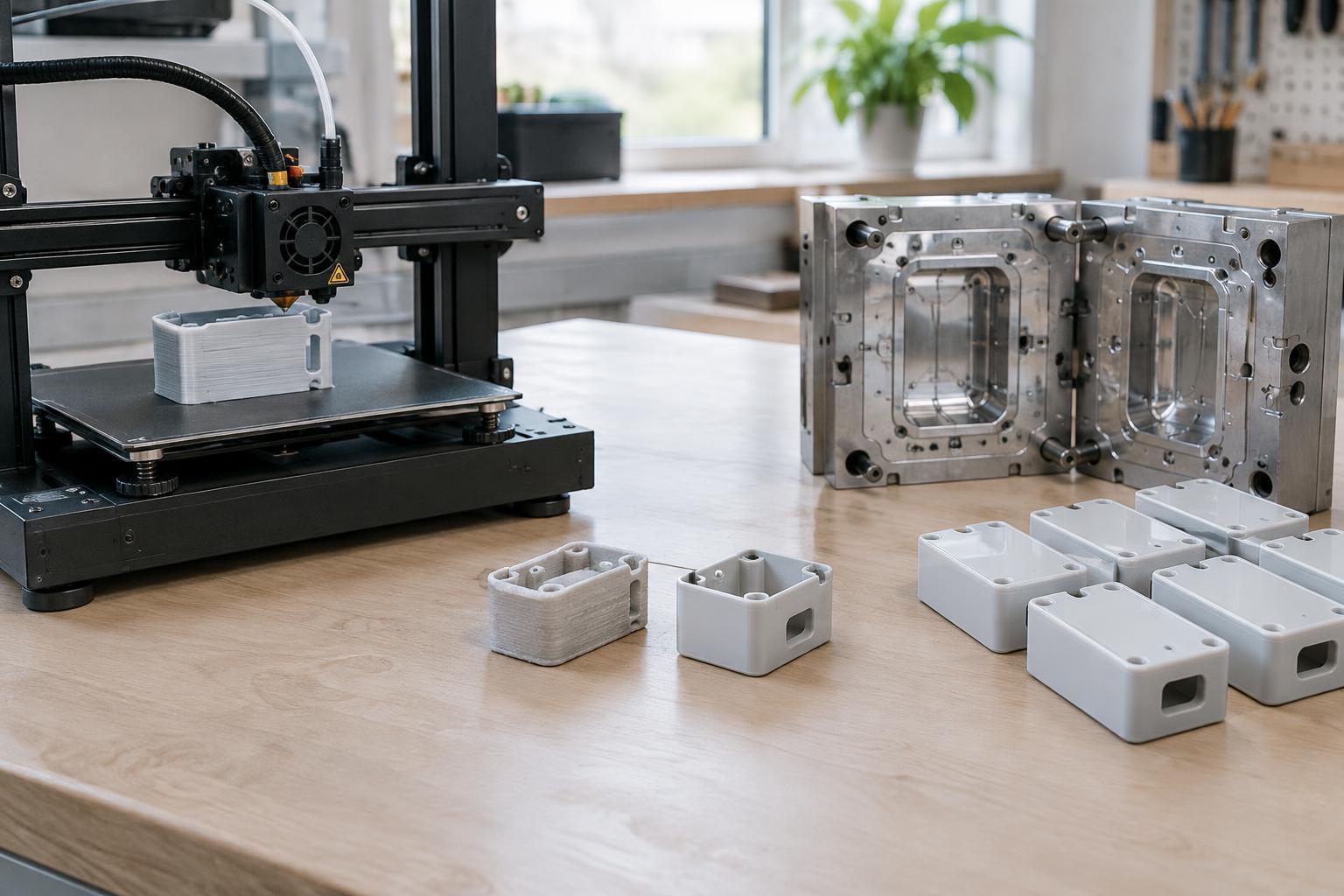
A design choice that suits one production method may be awkward for another. A 3D-printed enclosure can include shapes that would be difficult to release from a simple injection mold. A metal bracket that is easy to machine might be redesigned if the plan is to cut and bend it from sheet metal. Before refining a part, the team should ask what process is likely to make it, what that process handles well and which features might require extra operations.
The expected production volume also changes the conversation. A small batch may justify flexible methods and some manual assembly. A larger run may make dedicated tooling worthwhile, but it places more pressure on consistency and a repeatable assembly sequence. These are not reasons to settle every production detail on day one. They are reasons to make assumptions visible so they can be tested before the design is locked in.
Reduce complexity without removing useful features
Every separate part has to be made or purchased, tracked and handled during assembly. Combining two parts can simplify a product, provided the combined part is still practical to manufacture and replace. For example, molding a cable guide into a plastic housing might eliminate a separate clip. But combining an easily damaged component with an expensive housing could make repairs harder. The aim is not the lowest possible part count; it is a sensible balance between simplicity, performance and serviceability.
Small details can make assembly much easier. Parts that fit in only one orientation are less likely to be installed backward. Clear access to a screw allows a tool to approach it without colliding with another component. Reusing a fastener type can reduce tool changes and sorting. Features that hold a part in position while it is secured can free an assembler’s hands. Each choice may seem modest, but together they shape whether a product feels straightforward or frustrating to build.
Leave room for real-world variation
Physical parts are never identical in every dimension. Materials can vary, tools wear, and processes have normal ranges of variation. A product that relies on two surfaces meeting with no allowance for those differences may fit perfectly in a prototype and fail with another set of parts. Designers use tolerances to state which variations are acceptable, then consider how several variations might interact when parts are assembled.
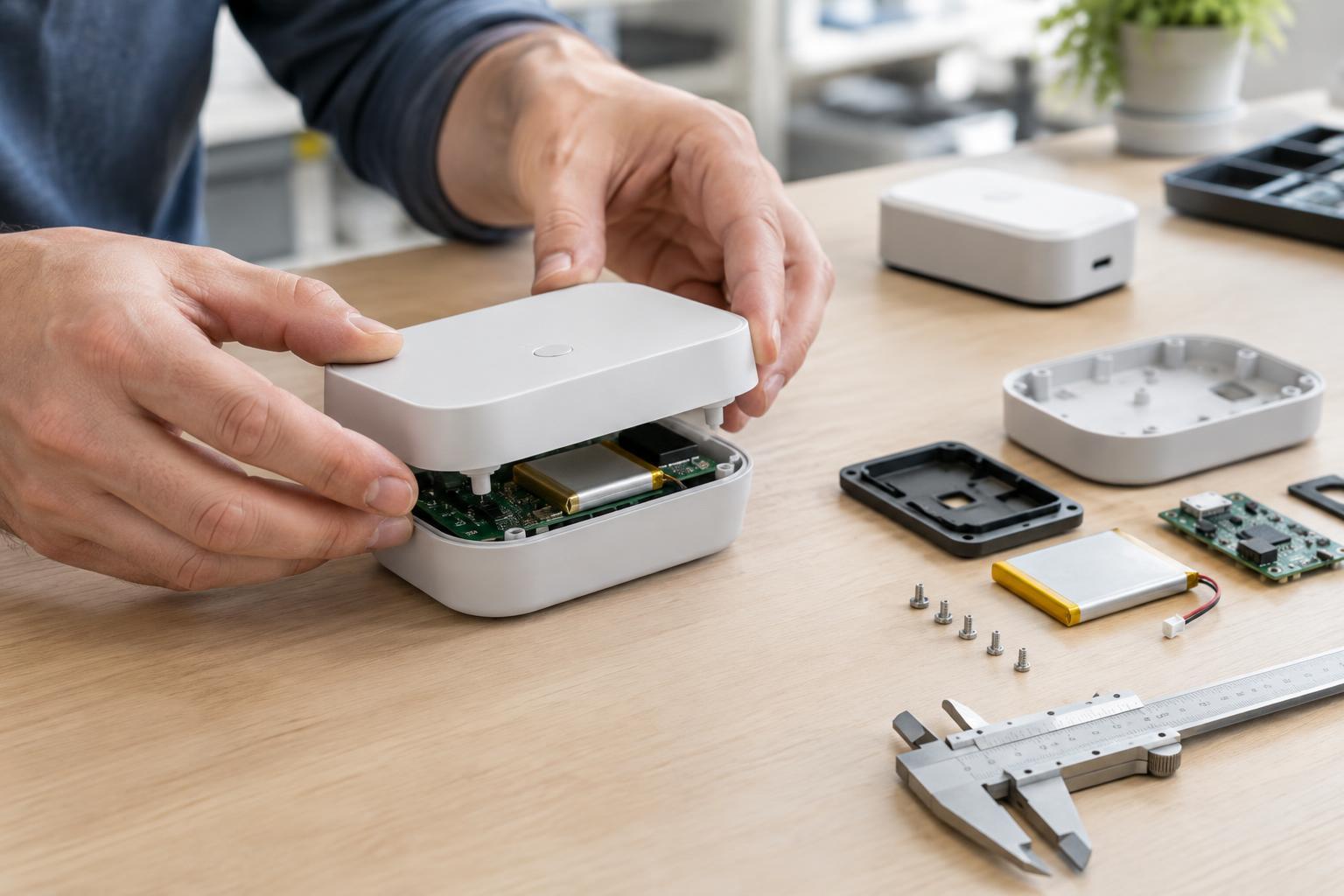
Consider a lid that must close over a circuit board and battery. If the board position, battery thickness and lid shape each vary slightly, a tight internal space may create interference. More clearance could solve that problem, though too much might let the battery move. The useful question is not simply “How precise can we make this?” but “Where does precision matter, and where can the design tolerate variation?” That distinction can support reliable assembly without demanding unnecessary precision everywhere.
Test the build, not just the finished product
Functional testing shows whether a product does its intended job. A build trial reveals different problems: which parts are easy to confuse, whether a connector is reachable, how often an adjustment is needed and whether a step depends on someone remembering an unwritten trick. Having someone other than the designer assemble a prototype can be particularly revealing. If they hesitate, the design may need clearer features or a better assembly sequence rather than more detailed instructions alone.
Early prototypes do not have to copy the final production method to be useful, but their limitations should be understood. A printed case can help check grip and component placement while saying little about how a molded case will behave. Later builds should more closely reflect the intended materials, processes and assembly steps. DFMA is an ongoing loop: make a design, try to build it, learn where the friction lies and revise it. The result is not merely a product that works, but one that can be made with less avoidable difficulty.