Start with the vehicle, not the charger
EV charging compatibility begins at the vehicle’s charge port. Check the owner’s manual or the manufacturer’s vehicle specifications for the AC connector, the DC fast-charging connector and any supported adapters. Do not rely on the shape of a port cover or on a listing that says only “EV charging”: a station may have several plugs, and your car may accept only some of them.
It helps to note three separate facts: the connector your car accepts, whether it supports AC charging or DC fast charging through that connector, and its maximum charging power under suitable conditions. Matching the plug is necessary, but it does not guarantee the advertised charging speed. The car controls how much power it accepts, and factors such as battery temperature and state of charge can affect a session.
Know the common connector names
Connector types vary by region and vehicle. In North America, J1772 is a common AC connector. CCS1 adds DC contacts to the J1772-style arrangement for fast charging. The connector often called NACS, also designated SAE J3400, has a different shape and can be used for AC or DC charging when the vehicle, equipment and connection support the intended mode. Some vehicles use CHAdeMO for DC charging.
In much of Europe, Type 2 is common for AC charging, while CCS2 incorporates a Type 2-style upper portion plus contacts for DC charging. Other markets use additional standards, including GB/T in China. These names describe connector families, not a promise that every station with a familiar-looking plug will serve every car. Check the connector information for your particular vehicle and the location where you plan to charge.
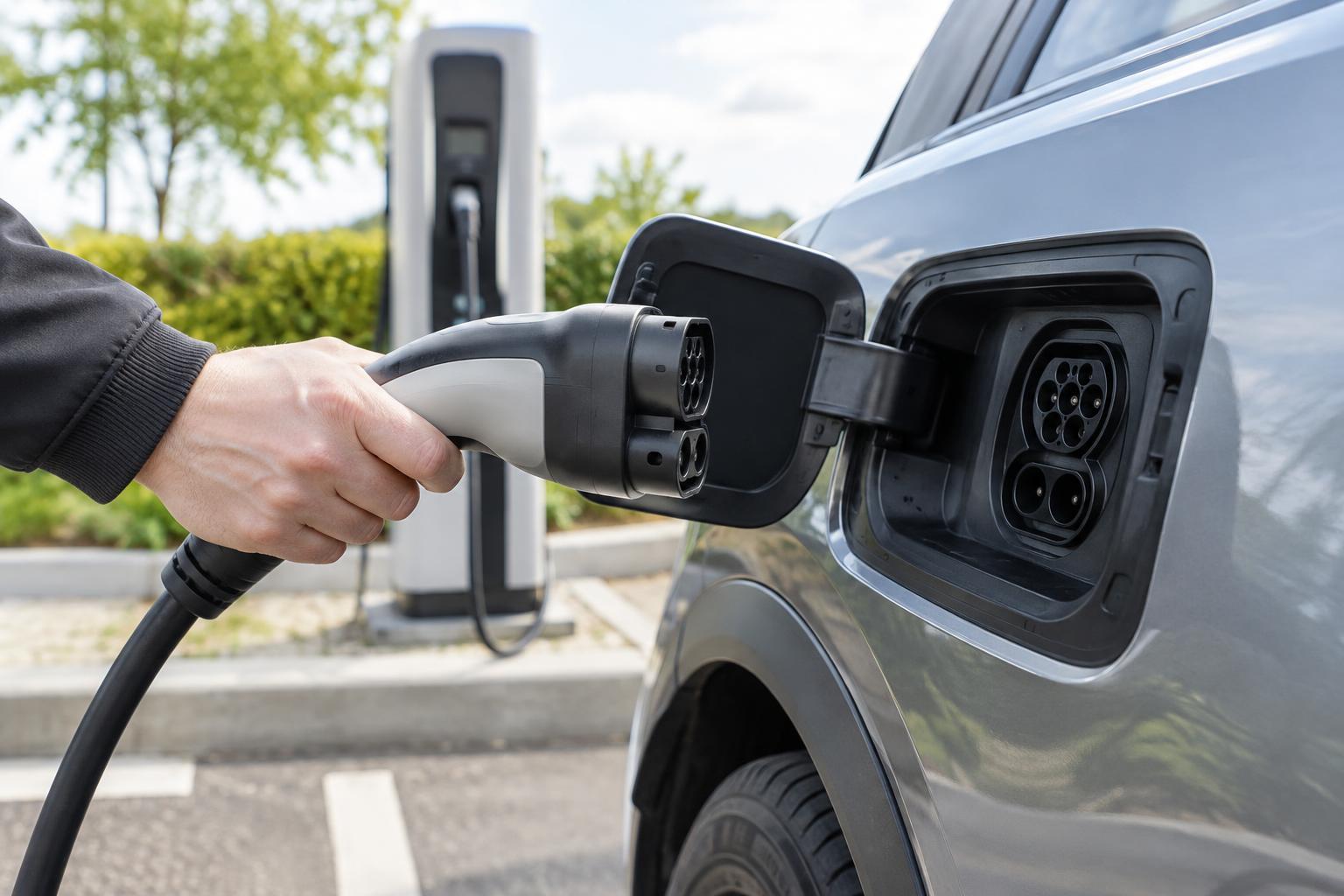
A combined charging system port can make the difference between AC and DC easier to spot: the larger CCS plug uses additional contacts for DC fast charging. An AC-only plug does not become a DC fast charger just because the station is described as high powered.
Match the charging method as well as the shape
At home or at many destination chargers, power is supplied as AC. The vehicle’s onboard charger converts it for the battery. At a DC fast charger, the station supplies DC power, allowing the vehicle to charge without relying on the onboard AC charger for that conversion. Your car’s supported charging methods determine which kind of station you can use.
When reading a station listing, look for its connector type and whether that connector is attached to an AC charger or a DC fast charger. Then compare its stated power with the limits listed for your vehicle. A charger rated above your car’s maximum is not automatically incompatible; the car can generally request less power. But a matching connector and a high station rating do not mean your car will charge at that rating.
Treat adapters as specific tools, not universal fixes
An adapter may let a vehicle use a charger with a different physical connector, but it must be approved for the particular vehicle, connector and charging method. AC and DC adapters are not interchangeable. Some charging networks or vehicles may also restrict which adapters or stations can be used, even when a plug can physically connect.
Before buying or packing an adapter, check the vehicle maker’s guidance and the adapter’s specifications. Confirm the direction of use: an adapter designed to connect one type of car to another type of charger does not necessarily work in reverse. Follow any power, handling and installation instructions. If support is unclear, choose a station with a connector your vehicle is explicitly listed as accepting.
Make a quick check before setting off
For a planned stop, compare your vehicle’s specifications with the station’s listing in this order: charging method, connector, adapter requirements and available power. Then check practical details such as access hours, payment method, cable availability and whether the charging space is accessible to your vehicle. A compatible connector will not help if the station requires an account you cannot set up on arrival.
Listings can be incomplete or outdated, and a site with several stalls may offer different connectors at each one. If a charging stop is important to your trip, identify a backup option. Keeping your vehicle’s connector and adapter details handy makes it easier to evaluate an unfamiliar charger without guessing from a photograph of the plug.