Positioning is more than arriving at a point
Imagine a robot arm placing a nozzle beside the edge of a product. The nozzle must reach the right location, face the right direction and remain steady while it works. Moving its tip to the correct point is only part of the job: an angled nozzle might apply material in the wrong place, while an unstable one might produce an uneven line.
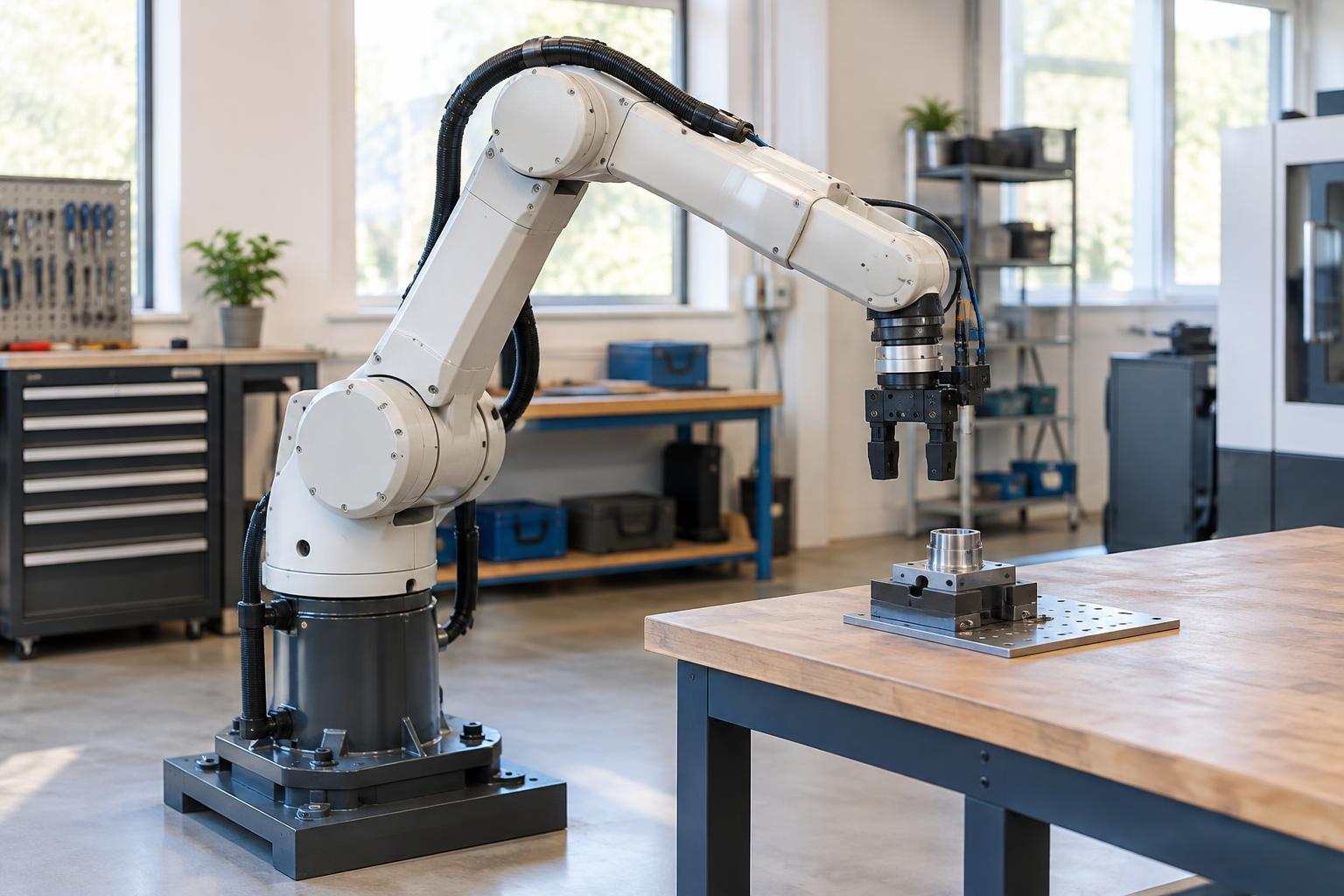
A robot arm positions a tool by moving its joints in a coordinated way. Each joint changes the position or orientation of the sections beyond it. The controller calculates joint movements from a requested tool position, then the motors and sensors help carry them out. The tool attached at the end of the arm is called an end effector. It might be a gripper, camera, suction cup or process tool, and its shape affects where the arm needs to move.
Reach describes an area, not just a distance
An arm’s reach is often described by how far it can extend, but its usable workspace is more complicated. An arm may reach a point directly in front of its base yet struggle to approach that same point from the side. Joint limits, the size of the tool and obstacles around the task all affect which positions and angles are practical.
Consider a camera inspecting the inside of a box. The arm needs enough reach to place the camera over the opening, but it also needs room to angle the camera without striking the rim. A longer arm can cover a larger area, although a compact arm may be easier to fit into a crowded workstation. When planning a task, it helps to trace the full route the tool must take—not merely check that its final destination falls within the arm’s maximum reach.
Payload includes everything the arm carries
Payload is the load an arm is designed to handle under specified conditions. It includes the tool, any mounting hardware and, for a gripper, the object being held. A gripper that is light when empty may become a much more demanding load after picking up a part. The load’s shape matters too: a long tool or an object held far from the wrist can place greater demands on the joints than a compact load of similar weight.
Payload and reach interact. Holding a heavy object close to the base is different from extending it outward, much as carrying a bag close to your body feels different from holding it at arm’s length. The intended speed and motion also matter. An arm may need to accelerate, stop and turn while carrying its load, not merely hold it still. For that reason, choosing an arm by matching a payload figure to an object’s weight alone can overlook important parts of the task.
Precision has more than one meaning
Precision is often used loosely, but two useful ideas are accuracy and repeatability. Accuracy asks how close the tool arrives to a requested position. Repeatability asks how consistently it returns to the same position after making the same move. An arm could repeatedly stop in nearly the same place while that place is slightly offset from the target. Calibration can help account for an offset, but it does not automatically solve every source of error.
The arm is also only one part of the positioning system. A tool can flex, a gripped object can slip, or a workpiece can sit differently in its fixture from one cycle to the next. A camera or other sensor may help the robot find a workpiece before moving, but sensing adds its own setup and measurement challenges. For a task such as placing a large box, small variations may be acceptable. Aligning a small connector may call for tighter control of the tool, the part and the surrounding setup.
Choose around the complete task
The practical starting point is the task at the tool tip. Where must the tool go, which way must it face, what must it carry and how consistently must it work? The answers help define a suitable workspace, payload allowance and positioning requirement. They also reveal whether a fixture, a different end effector or a changed layout could make the job easier without requiring a larger arm.
Established robot arms already perform repetitive positioning tasks in controlled settings. More flexible workspaces, where objects and people move unpredictably, present additional challenges for sensing, planning and safe operation. Whatever the setting, reach, payload and precision are not independent scores to maximize. A useful robot arm is one whose capabilities fit the entire motion—from a clear approach to a reliable result.