Stored energy and the accelerator pedal
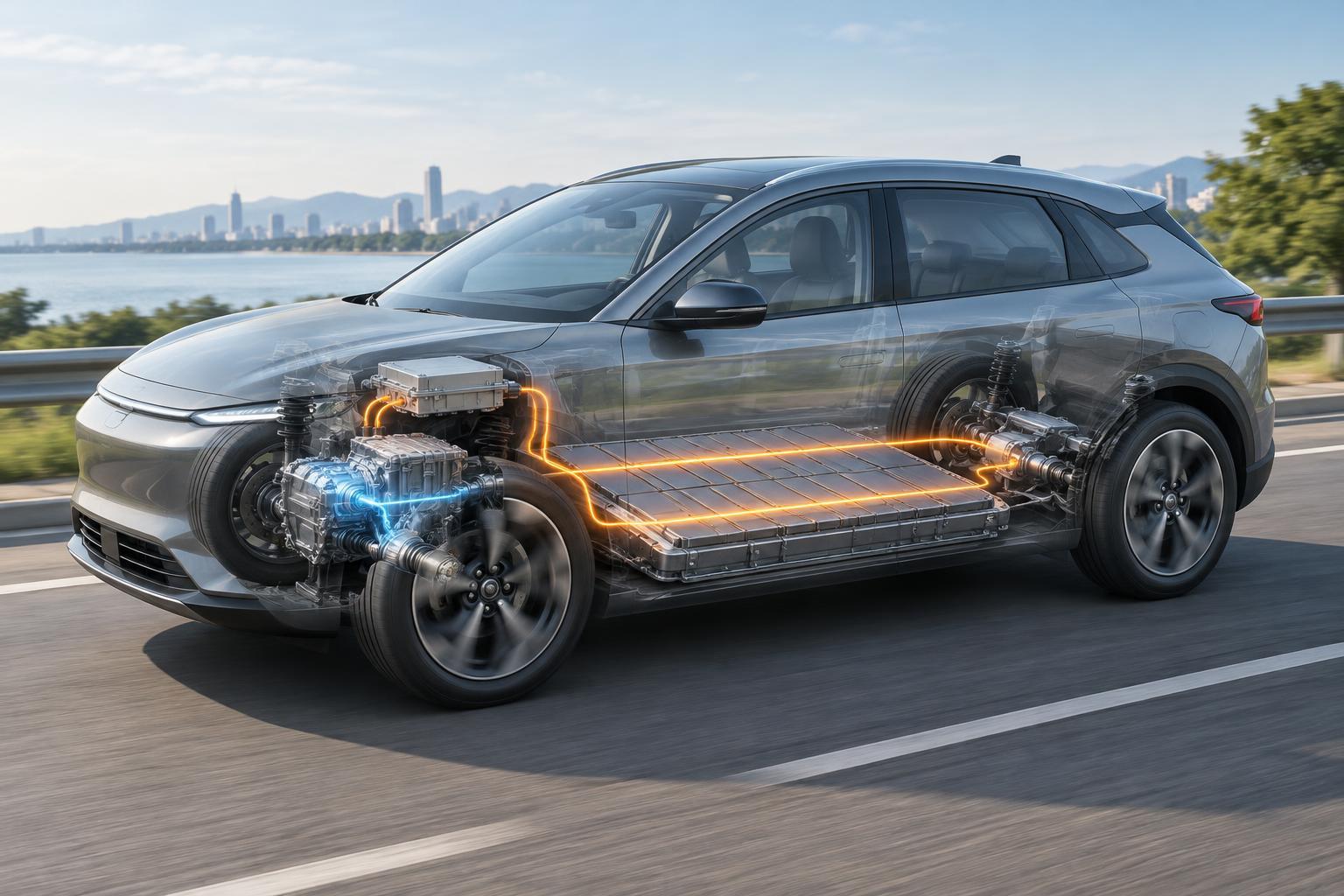
An electric car carries energy in a rechargeable battery pack. The pack contains many individual cells grouped and connected so they can supply the power the vehicle needs. That power is delivered as direct current, or DC: electricity that flows in one direction. A battery management system monitors the pack and helps keep its cells within operating limits.
Pressing the accelerator does not simply connect the battery to the wheels. It tells the car’s control systems how much driving force the driver wants. Those systems consider factors such as vehicle speed, battery conditions and available grip, then command the electrical components to deliver an appropriate amount of power. This control helps make the car responsive at low speeds without asking every component to work at full output all the time.
The inverter and motor do the conversion
In many electric cars, the main drive motor uses alternating current, or AC. An inverter converts the battery’s DC electricity into AC and controls its timing and frequency. By changing the electricity supplied to the motor, the car can control how strongly and how quickly the motor turns.
Inside the motor, magnetic forces create rotation. A stationary part called the stator produces a changing magnetic field, which acts on a rotating part called the rotor. The result is torque: the twisting force that drives the vehicle. Motor designs vary, so the details of how their magnetic fields are produced differ, but the basic task is the same—turn electrical energy into mechanical motion.
An electric motor can provide strong torque from a standstill, which is one reason electric cars often feel quick when pulling away. That does not mean the battery, motor or tires can deliver unlimited force. The vehicle’s controls manage output to suit the components and conditions.
From the motor to the road
The motor’s rotating shaft must pass its force to the wheels. Most electric cars use a reduction gear to turn the motor’s relatively fast rotation into a slower, stronger rotation suited to driving the wheels. Many also use a differential, which lets the left and right driven wheels turn at different speeds around a corner. The tires then push against the road, moving the car forward.
Unlike a typical combustion-engine car, an electric car usually does not need a gearbox that shifts through several driving ratios. Its motor can work across a broad range of speeds, so one fixed reduction ratio is often enough. Layouts still vary: a car might drive one axle with one motor, or use motors at both axles for all-wheel drive. In either case, the chain of work remains recognizable: battery, power electronics, motor, drivetrain and wheels.
Slowing down can send energy back
When a driver eases off the accelerator or presses the brake, an electric car can use its drive motor as a generator. The turning wheels keep the motor spinning, and some of the vehicle’s motion is converted into electricity that flows back toward the battery. This is regenerative braking.
Regeneration can recover energy that would otherwise be lost as heat in the brakes, but it cannot recover all the energy used to get moving. Energy is also lost to air resistance, tire deformation and heat in electrical components. The amount recovered depends on conditions, including vehicle speed and whether the battery can accept a charge. Conventional friction brakes remain necessary for reliable stopping, especially when more braking force is needed.
What affects the journey
Not all the energy stored in a battery reaches the road. The inverter, motor and gears each have losses, and the car also uses electricity for systems such as cabin heating, cooling and battery temperature control. Once moving, it must overcome rolling resistance and push air aside. Higher speeds generally make air resistance a more important part of the energy demand.
This explains why driving range is not determined by battery size alone. Vehicle shape and weight, tire choice, speed, terrain, weather and use of cabin controls can all affect how far a charge takes a car. The core technology—controlled electricity turning a motor and driving the wheels—is established in cars on the road today. Future motor and battery designs may refine it, but they will still have to manage energy, motion and the losses between them.