A map is only half the problem
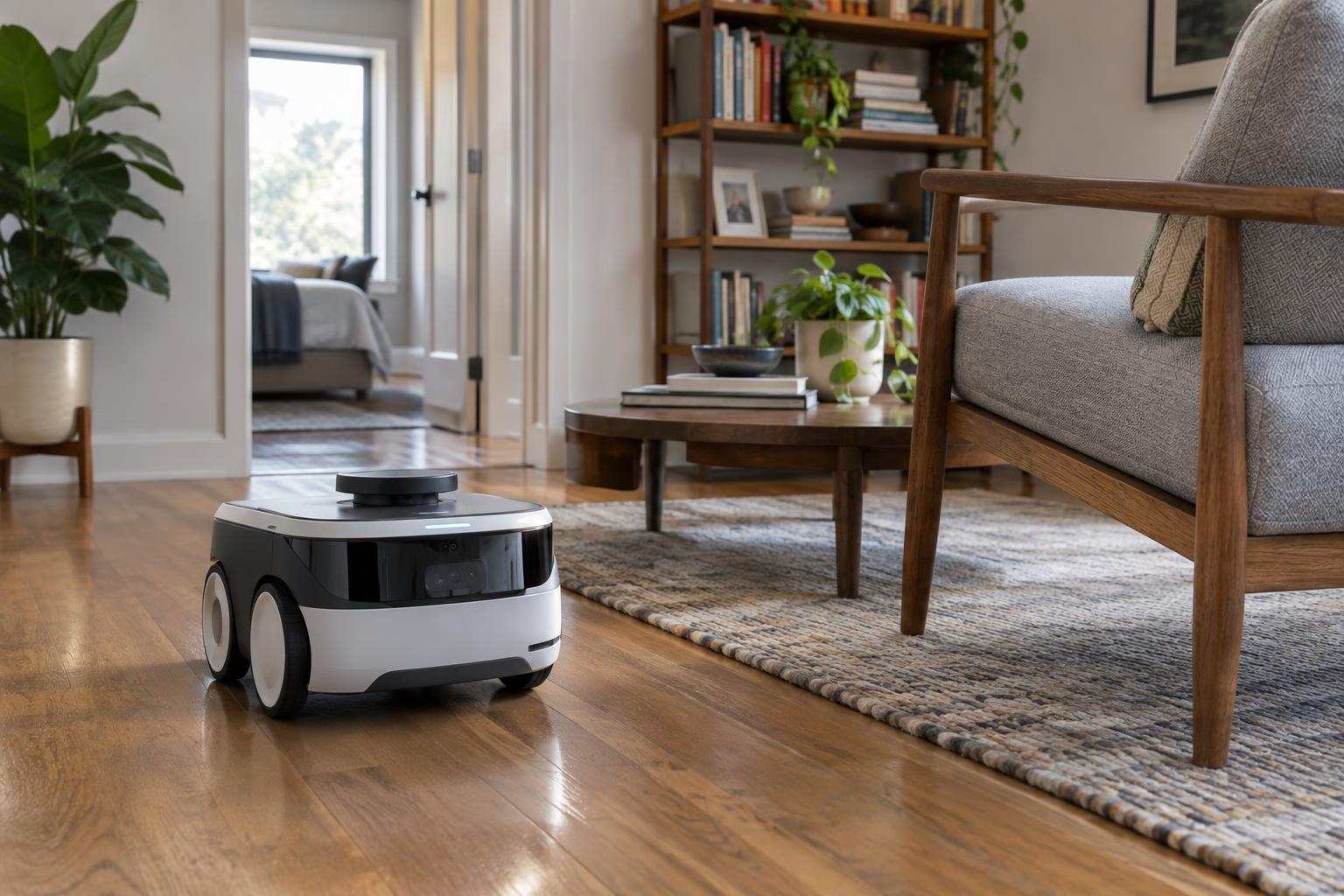
Imagine a robot vacuum entering a room for the first time. It needs to learn where it can travel, but it also needs to know where it is on the map it creates. Those are related tasks, not the same task. A floor plan is of little use if the robot cannot tell whether it is beside the sofa or near the doorway.
Indoor robots often begin with incomplete information. Furniture blocks their view, doors may be open or closed, and people or pets can move through the space. Rather than capturing a perfect picture at once, a robot gathers observations as it travels. Its map is a working model that helps it choose routes and avoid obstacles.
How a robot gathers clues
Different robots use different combinations of sensors. A camera can observe visual features, while a laser distance sensor can measure how far away nearby surfaces are. Some devices use depth cameras or short-range sensors to detect obstacles. Wheel encoders estimate how far the wheels have turned, and motion sensors can help detect changes in direction. Each provides a clue rather than a complete answer.
Movement estimates are especially useful between observations of the room, but small errors accumulate. A wheel may slip on a rug, or the robot may turn a little farther than expected. After enough travel, its estimated position can drift away from its actual position. Observations of walls, corners or other recognizable features help correct that drift.
Building a map while moving
A robot starting without a map faces a puzzle: it must estimate its position to place observations on a map, yet it needs a map to check its position. The family of techniques used to tackle this is called simultaneous localization and mapping, or SLAM. The robot combines its movement estimates with new sensor readings, updating its best estimate of both the surroundings and its own path.
The resulting map need not resemble an architectural drawing. For navigation, it may mark areas as free, blocked or not yet explored. Another approach records distinctive features or places and how they connect. When the robot returns to a familiar area, it can compare new observations with earlier ones. Recognizing that it has completed a loop can help it adjust a path that has gradually drifted.
Finding its position on a known map
On a later trip, a robot may load a saved map and try to match what it currently senses to that map. It might initially consider several possible positions, then narrow them down as it moves and sees more of the space. A long, plain hallway can be ambiguous; a particular doorway beside a corner may provide a stronger clue.
This process is called localization. It continues throughout a trip because the robot cannot rely on one successful match forever. If it is picked up and placed elsewhere, its previous position estimate may be wrong. Some robots can recognize the new location after collecting enough observations; others may need to explore or ask for help. The outcome depends on the device and how distinctive the surroundings are.
Why real rooms remain difficult
An indoor map is not a promise that every journey will be smooth. A chair moved across a doorway may block a planned route, while a temporary object should not necessarily become a permanent wall on the map. Lighting changes can affect cameras, and reflective or transparent surfaces can complicate some distance measurements. Robots therefore need to respond to what is in front of them now, even when a saved map suggests a clear path.
Mapping and localization are established parts of many indoor navigation systems, including some robot vacuums and warehouse robots. More capable navigation in busy, changing homes remains a harder goal. If a device stores camera images or detailed maps, its privacy settings and data-handling choices are worth checking. For a user, the most useful map is not the most elaborate one: it is one that helps the robot navigate reliably while making its limits understandable.