Why methane leaks are hard to spot
Methane is the main component of natural gas and a potent greenhouse gas. It can escape from equipment used to produce, process, store and transport gas. A leak might come from a faulty valve, a loose connection or a piece of equipment operating differently than intended. Because methane is invisible to the human eye, finding its path from a particular component can take more than a routine visual inspection.
Detection tools answer different questions. A sensor near a facility can indicate that methane is present. A camera may show where gas is moving. An aircraft or satellite can scan a much wider area for a plume. None of those observations automatically identifies the exact broken part or proves how long the release has been happening. The most useful approach is often to narrow the search from a broad area to a specific piece of equipment.
Ground sensors: close-up checks and ongoing alerts
Handheld methane detectors help workers check valves, fittings and other likely leak points at close range. Fixed sensors can monitor selected locations and alert operators when readings rise. These are established tools, but placement matters: a sensor cannot detect every release across a large site if the gas never reaches it. Wind, obstacles and the height of a leaking component can all affect what it measures.
Some instruments measure how methane absorbs light at particular wavelengths. Others sample the surrounding air. A concentration reading describes the methane present at the instrument, not necessarily the rate at which it is escaping. To investigate an alert, workers may check nearby equipment, repeat measurements and consider whether an expected operating activity could explain the reading.
Infrared cameras and mobile surveys
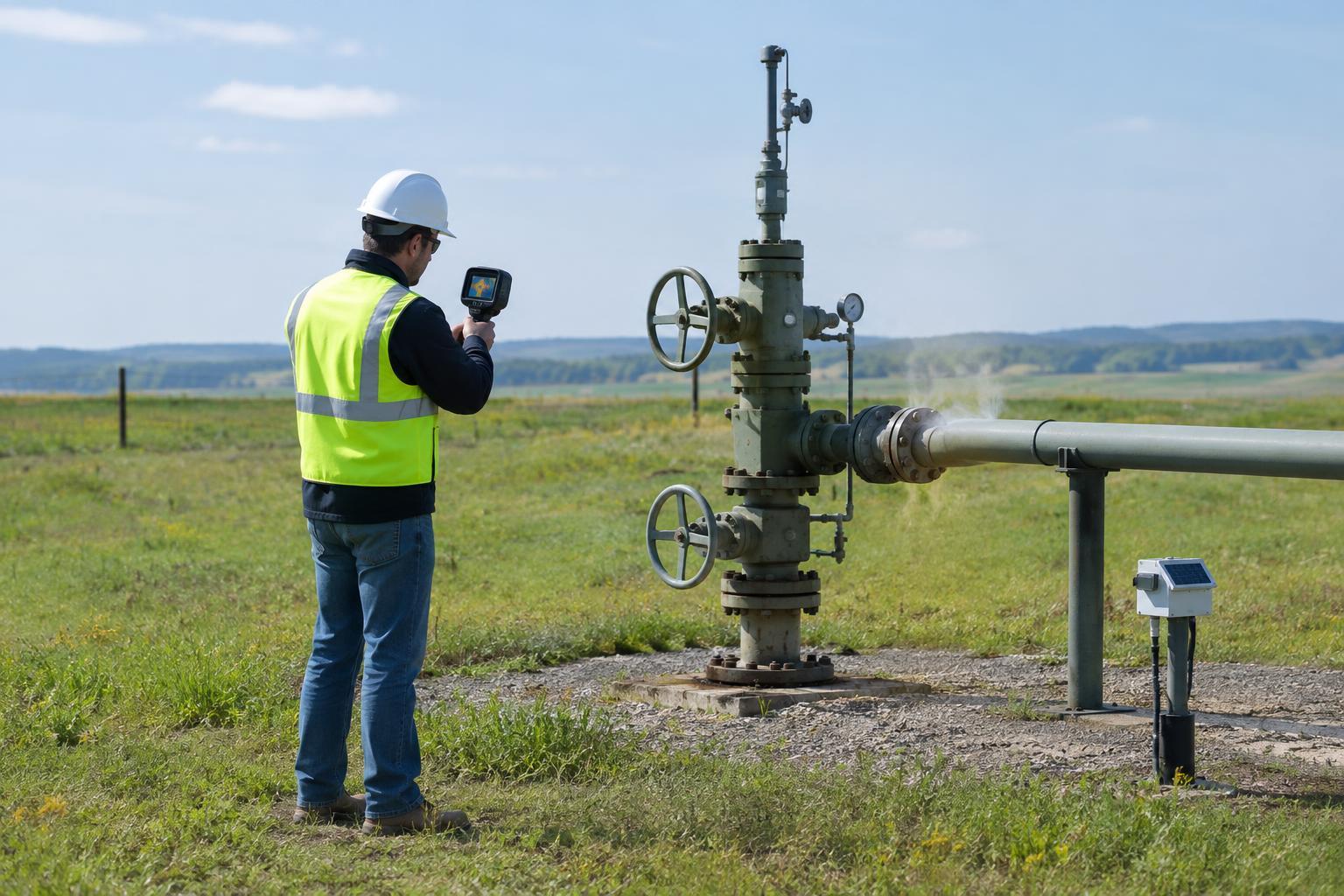
Specialized optical gas imaging cameras can make certain gas plumes visible on a screen by detecting infrared differences between the gas and its background. This can help an inspector see gas moving from an otherwise ordinary-looking connection. The result depends on conditions: a small leak may be difficult to see, and a plume can be less distinct against some backgrounds or in changing weather. Camera footage is a useful clue, not a complete measurement on its own.
Vehicle-mounted instruments, drones and aircraft can cover more ground than a person walking a site. They are useful for screening long pipelines or groups of facilities, though their readings need interpretation. A passing survey may miss an intermittent release, while a signal observed from above may require a ground visit to determine which component is responsible.
What satellites can—and cannot—see
Some satellites can detect methane by measuring sunlight reflected from Earth after it has passed through the atmosphere. Methane absorbs particular wavelengths, allowing instruments to look for unusual concentrations. Satellite observations can help identify large plumes and direct attention to places that might otherwise go unchecked, especially across extensive infrastructure.
They do not provide a continuous, close-up view of every pipe. Clouds, viewing conditions, instrument resolution and the size of a release can limit what is detectable. Estimating a release rate from a plume also involves assumptions about wind and how the gas disperses. A satellite finding is therefore best understood as a lead to investigate, rather than a diagnosis of a specific failed valve.
Turning a detection into a repair
A useful leak-detection process connects observation to action. An operator might use a wide-area survey to flag an unusual signal, send a team to the site, pinpoint its source with closer-range tools, make a repair and check again afterward. Rechecking matters because a falling reading in one location does not always mean the underlying problem has been fixed.
New systems aim to combine repeated observations from fixed sensors, mobile surveys and satellites so that unusual patterns are easier to notice. Such systems may help prioritize inspections, but they still depend on reliable measurements and human follow-up. The goal is not simply to produce a map of methane: it is to find releases accurately enough that people can address them and verify the result.