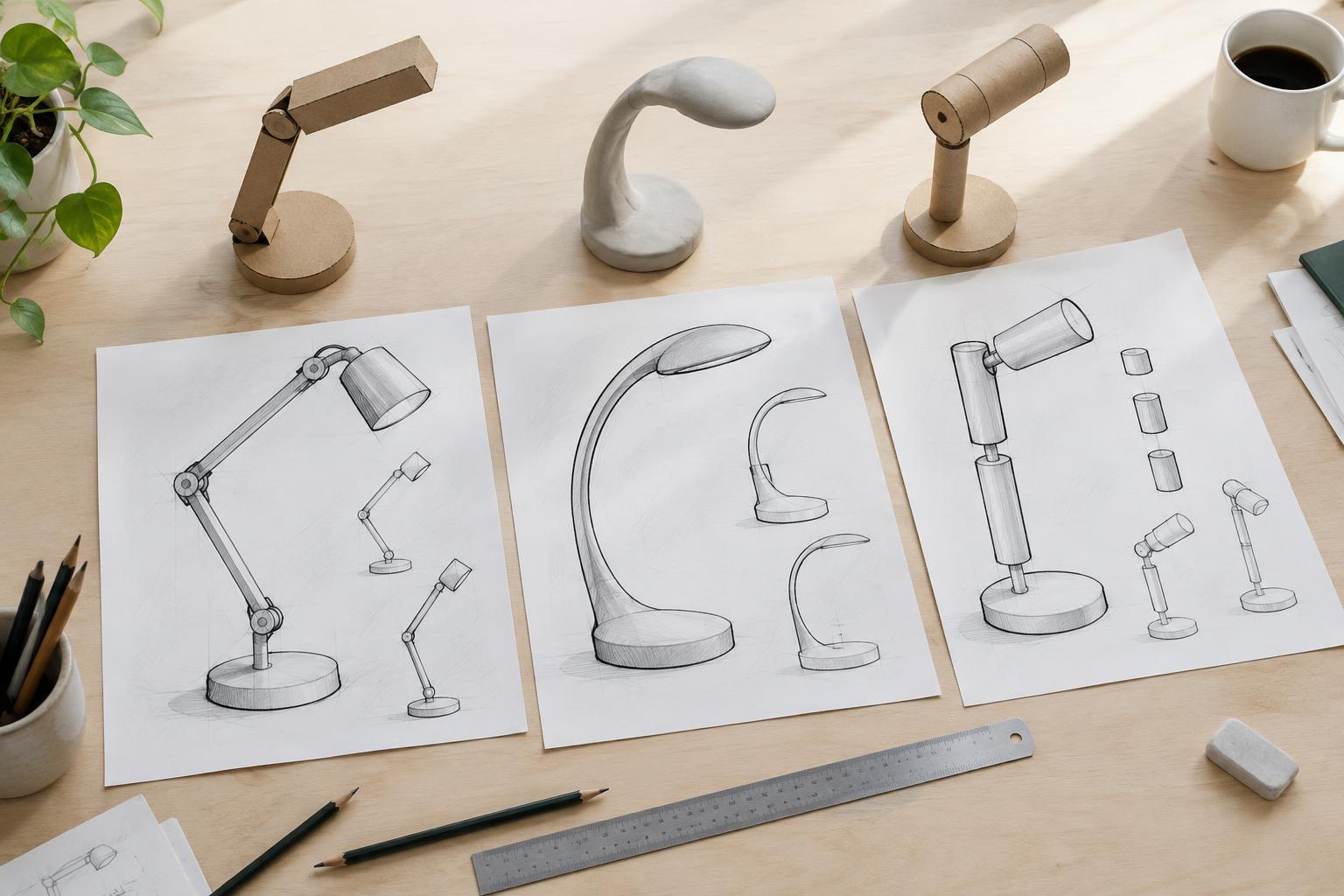
Start with the problem, not the first solution
A design brief often suggests an answer before anyone has explored the question. “Make a better smart thermostat,” for example, directs attention toward a wall-mounted device. A more open brief might ask, “How can people understand and adjust their home’s heating without unnecessary effort?” That wording leaves room for a simpler display, a phone interface, clearer controls on an existing thermostat, or an entirely different approach.
Before sketching, write down who the design is for, what they are trying to do, and where the difficulty occurs. Then separate requirements from assumptions. A requirement might be that someone can change the temperature without a phone. An assumption might be that the control needs a touchscreen. Treating those differently creates room for alternatives while keeping the concepts relevant.
Use prompts that force different directions
One practical method is to generate concepts in rounds, with a different prompt for each round. First, sketch the simplest version that could solve the problem. Next, sketch a version designed for a person using it for the first time. Then consider one that works with limited space, attention, connectivity, or power. These prompts are not predictions about what users will prefer; they are ways to expose choices that one unrestricted brainstorm might miss.
You can also change one design variable at a time. For a household control, compare a physical dial, a set of buttons, and a screen. Then compare where each could live: on a wall, on an appliance, or in a portable device. Mixing and matching these variables can produce several concepts quickly. Some combinations will be impractical, but even a rejected pairing can reveal a useful feature, such as a physical control that remains usable when a screen is off.
Sketch separately before combining ideas
In a group, the first idea spoken aloud can become the default. Give each participant a short period to make rough sketches or written descriptions independently before discussing them. Artistic skill is not the point: boxes, arrows, and brief notes can show what a person does, what the design does in response, and what happens if something goes wrong.
After sharing, group similar proposals and ask what makes each distinct. If three sketches all show the same phone app with different colors, they may be variations of one concept rather than three alternatives. Try changing the interaction, the location of the control, or the amount of information shown. It is fine to combine promising elements later, but preserve the original options long enough to understand what each contributes.
Give constraints a deliberate role
Constraints can improve ideation when they are specific and relevant. A team designing a compact charging station could ask how it would work without a display, with one-handed use, or when several people need to identify their own devices. Each constraint encourages a different solution. An arbitrary challenge can be playful, but it should not replace the real limits of the project, such as available space, accessibility needs, maintenance, or cost targets.
Avoid making every concept satisfy every preference immediately. In an early round, allow one idea to prioritize simplicity and another to prioritize flexibility. Note the trade-offs rather than hiding them. A concept with fewer controls may be easier to approach but slower for someone who makes frequent adjustments. Recording that tension makes the next design decision more informed.
Compare concepts before choosing one
Once you have a small set of genuinely different concepts, describe each in the same format: the user’s goal, the main interaction, the likely benefit, and the biggest unanswered question. Compare them against the brief rather than against how polished the sketches look. Useful criteria might include ease of use, accessibility, feasibility, repairability, and how clearly the concept addresses the original problem.
A comparison does not have to produce an immediate winner. Build a simple paper mock-up, act out a use scenario, or ask someone to explain what they think a sketch would do. Such checks can reveal confusion before time is spent refining details. Keep at least one alternative available during early testing: if the leading concept fails, the team can return to a different direction instead of starting from scratch. The goal of ideation is not to generate the most drawings; it is to create meaningful choices.