Two approaches to working with machines
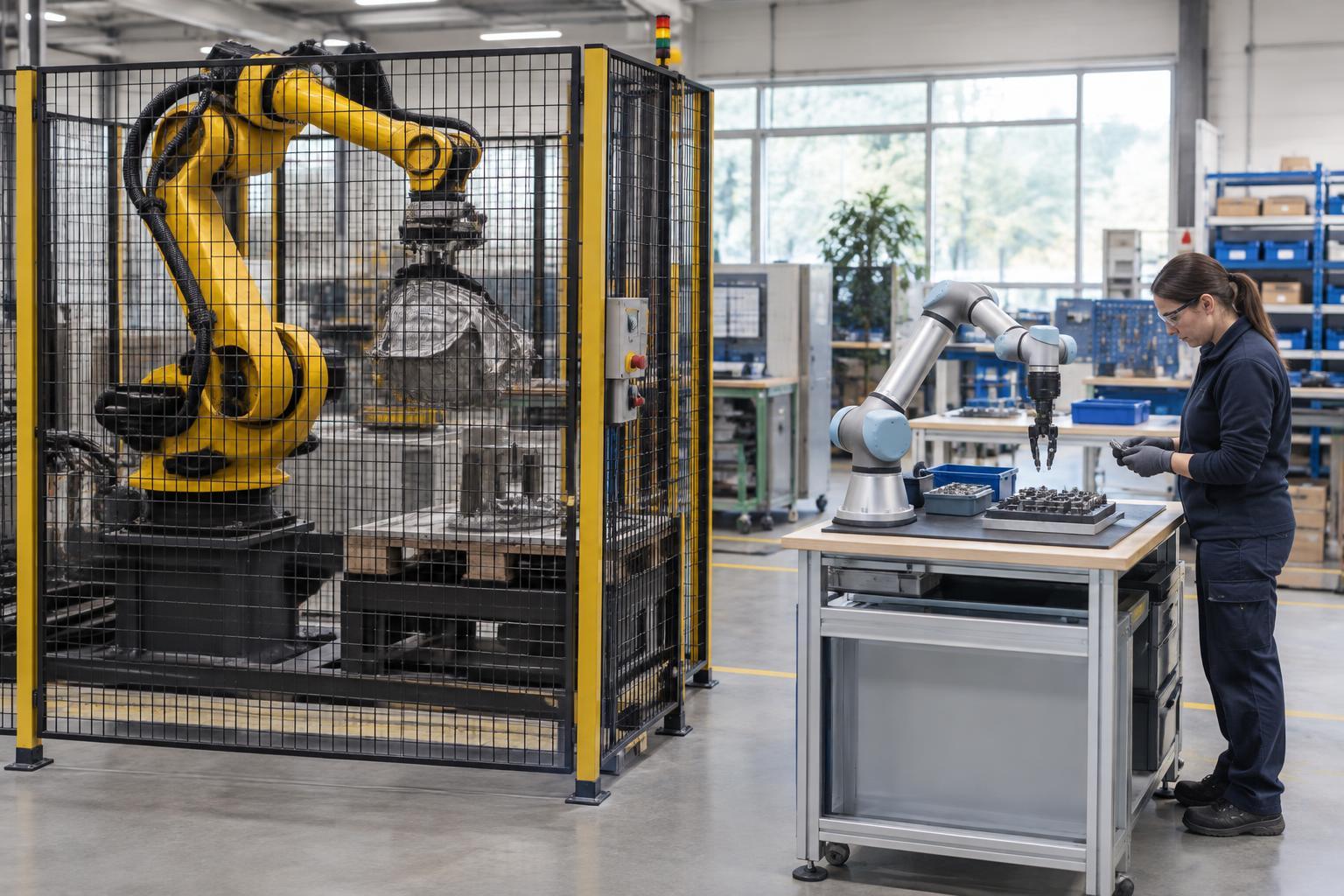
An industrial robot arm might lift a heavy part, weld a joint or place a component in the same position thousands of times. A collaborative robot, often called a cobot, might hold a part while a person assembles it or help load a machine in a shared work area. Both are programmable machines with joints and tools. The main difference is how they are intended to operate around people.
Traditional industrial robot installations commonly separate the moving arm from workers with guards, interlocked doors or other protective measures. Collaborative applications are designed so that people and robots can work closer together under defined conditions. That does not mean every cobot can safely run beside a person at any speed, or that an industrial arm can never be used in a collaborative setup. The task, tool, workpiece and surrounding equipment all matter.
Safety depends on the whole application
Many cobots include features such as force limits or motion monitoring that can help reduce the risk of contact. In some applications, the robot may slow down when a person approaches or stop when contact is detected. These features support closer interaction, but they are not a substitute for assessing the complete workstation. A gripper holding a sharp metal part, for example, presents a different hazard from an empty gripper moving through the same space.
An industrial arm behind a protective barrier can be a sensible way to handle a fast or hazardous process. A cobot may be more suitable when a person needs frequent access to the task. Either way, the safe operating arrangement depends on factors such as the robot’s motion, the load it carries, where a person could be caught and what happens if something goes wrong. “Collaborative” describes a way of working, not a blanket safety guarantee.
Speed, payload and reach shape the choice
Industrial robot arms are available for a wide range of jobs, including moving large or heavy items and repeating motions at high speed. When a production step is well defined and people do not need to enter the robot’s workspace during operation, an enclosed industrial cell can make good use of that capability. Think of an arm transferring parts between machines or repeatedly applying a coating along the same path.
Cobots are often chosen for lighter handling and shorter-reach tasks where access and adaptability matter more than maximum speed. A shared workspace may require the robot to move more slowly or stop when a person enters a particular area. The relevant comparison is therefore not just how fast each arm can move on its own. It is how much useful work the entire station can complete while meeting its safety requirements.
Setup and flexibility in everyday use
A cobot can be appealing when a team expects to change tasks or products regularly. Some can be taught a new path through guided movement or a visual programming interface, reducing the effort needed for simple changes. A small workshop might use one arm to tend a machine in the morning and assist with packing later. Switching tasks still takes planning: the team may need a different gripper, fixtures, instructions and a fresh look at the hazards.
Industrial robot cells can also be reprogrammed, and a well-designed cell may handle multiple product variations. They can, however, involve more extensive guarding and integration when a process is fast or complex. Neither type is automatically the cheaper choice. The arm is only part of the installation; tooling, sensors, space, training, maintenance and time spent adapting the process can all affect the decision.
Choose the work pattern before the robot label
Start with the job: What must be moved or processed, how far, how often and with what level of consistency? Then ask when people need access. If an arm will repeat a fast, demanding operation in a dedicated area, a guarded industrial cell may be a better fit. If a person needs to share a workspace with an arm doing a modest handling task, a collaborative application may be worth considering.
These are established approaches, not competing visions of a distant future. Future workstations may offer easier programming and more responsive sensing, but those possibilities do not remove the need to match a robot to a real task. The most useful distinction is not whether an arm is called industrial or collaborative. It is whether the complete setup can do the work effectively while managing the risks of that particular workplace.