Two ways to turn a command into movement
Imagine asking a robot arm to move a cup across a table. It needs a command: move in a particular direction for a particular distance. But how does it know whether the cup reached the intended spot? The answer depends on whether the robot checks what happened while carrying out the command.
In open-loop control, a controller issues an action without using feedback about the result to correct that action. In closed-loop control, it compares a measured result with a target and adjusts its commands to reduce the difference. Both approaches can be useful. The choice depends on the task, the environment and how much accuracy is needed.
How open-loop control works
An open-loop controller follows a preset instruction. For example, a small robot might power its wheels for a set time to travel across a clear floor. It assumes that the wheels will grip as expected and that nothing will block the route. If the floor is slippery or one wheel turns more slowly than the other, the robot may stop somewhere other than the intended position.
Open-loop control can be straightforward when conditions are predictable. A robot that repeats a simple motion in a controlled workspace may not need to measure every part of that motion. It is also possible to plan a complex sequence of movements in advance. The defining feature is not simplicity; it is that the controller does not use a measurement of the outcome to correct the action in question.
How closed-loop control responds
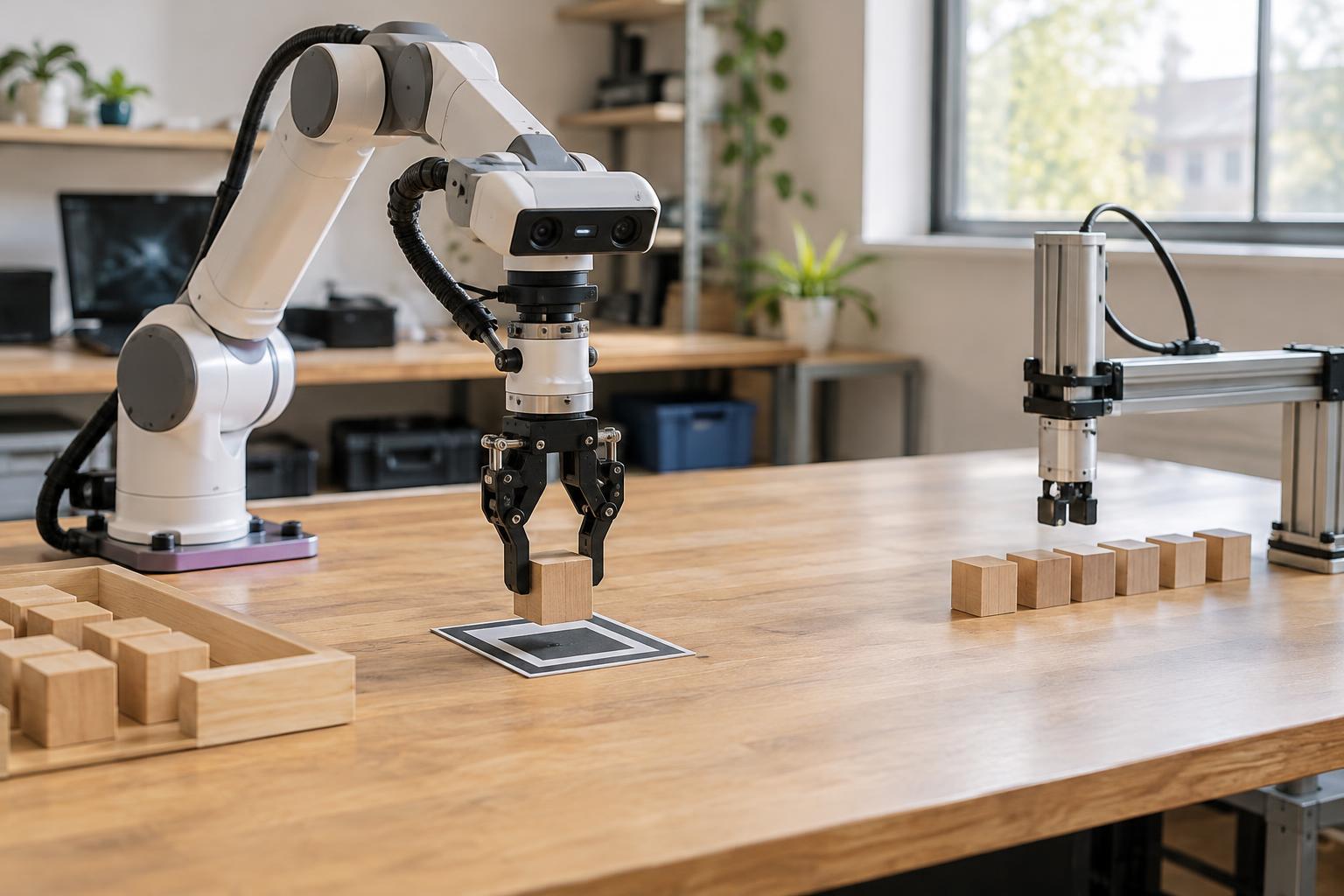
A closed-loop controller uses a feedback cycle: measure, compare and adjust. Suppose a robot arm needs to rotate a joint to a target angle. A position sensor reports the joint’s current angle. If it has not moved far enough, the controller continues driving the motor; as it approaches the target, the controller can change the motor command. If an unexpected load slows the joint, the controller can respond to the measured difference.
A robot vacuum offers another everyday example. Rather than relying only on an instruction to drive forward for a fixed time, it can use sensors to detect an obstacle and alter its route. Feedback does not make a robot infallible, however. A sensor may miss an object, produce a noisy reading or report information too late for the robot to react smoothly. A controller must be designed around what its sensors can reliably measure.
Why robots often use both
Open-loop and closed-loop control are not labels that must apply to an entire robot. A machine can plan a route in advance while using wheel sensors to keep track of its movement. It might command an arm to follow a planned path while using joint sensors to correct each motor’s position. In this arrangement, the overall plan is preset, but parts of its execution rely on feedback.
The distinction also depends on the outcome being discussed. A robot arm may use closed-loop control to reach a joint angle without sensing whether the object in its gripper has slipped. It can be closed-loop for joint position yet effectively open-loop for the object’s final placement. Adding a camera or grip sensor could provide feedback about that separate goal, though interpreting the new measurements introduces another design challenge.
Choosing the right approach for a task
A useful question is: What could change between issuing a command and completing it? If the answer is very little, a preset action may be sufficient. If wheel slip, changing loads, moving people or uncertain object positions matter, feedback can help the robot adapt. The desired accuracy matters too: a small positioning error may be harmless when moving through an open room but problematic when aligning a gripper with a delicate object.
Feedback comes with trade-offs. Sensors, processing and careful tuning add complexity, and a controller that reacts too strongly to every measurement can overshoot or make a motion unsteady. The aim is not to add feedback everywhere. It is to measure the outcomes that matter and use those measurements to make useful corrections. That is the practical difference between a robot that merely carries out a command and one that can respond when reality differs from the plan.