Two questions every moving robot must answer
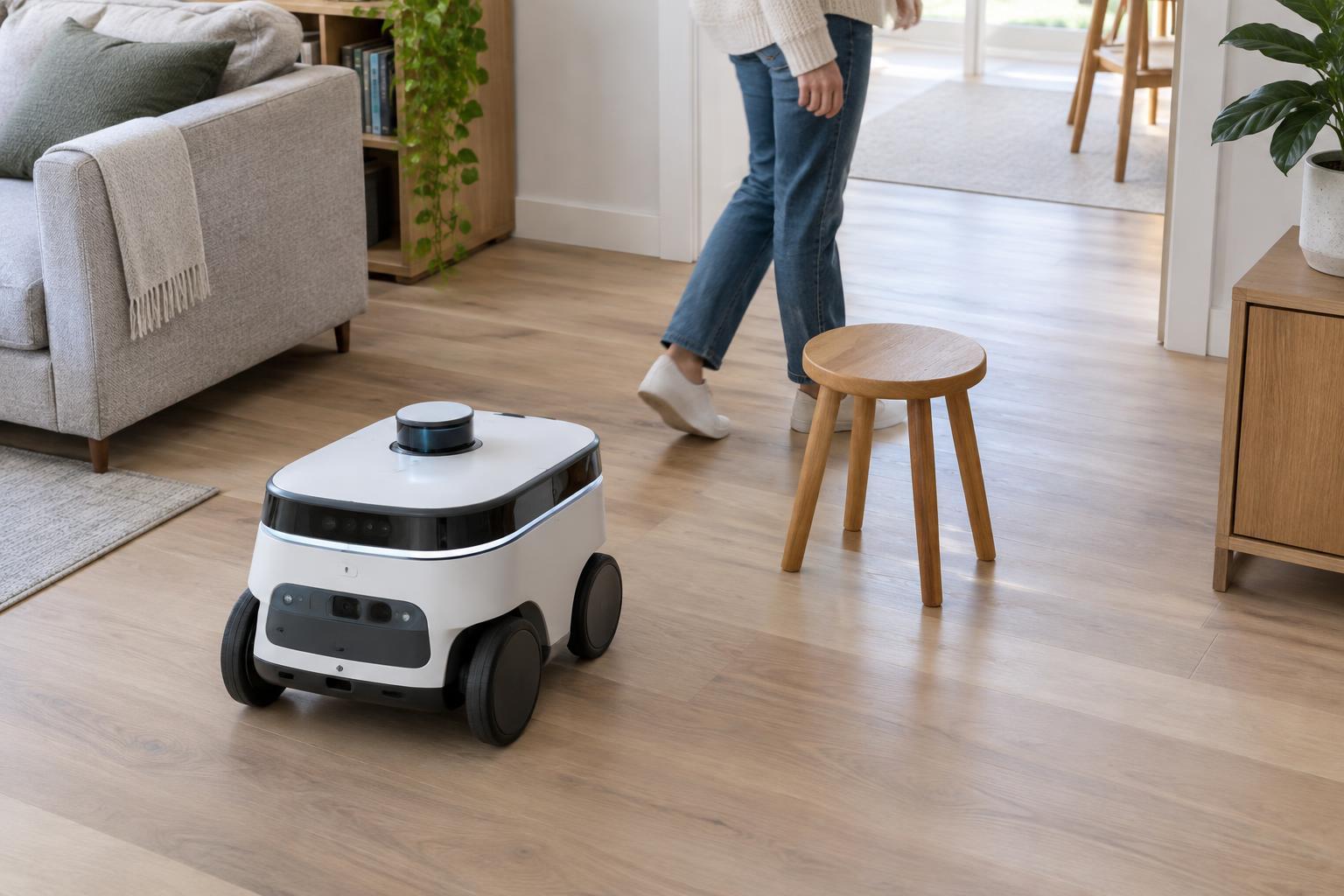
Imagine a delivery robot crossing an office to reach a meeting room. It needs a route through the corridors, but it also needs to slow down if someone steps out of a doorway. Those are related tasks, not the same task. Path planning asks, “How can I get from here to there?” Obstacle avoidance asks, “What should I do about something in my way right now?”
Planning usually considers a larger area and a longer stretch of the journey. Avoidance deals with nearby hazards and shorter time horizons. A robot that can plan but cannot avoid may follow a good route into a newly placed chair. A robot that can avoid but cannot plan may steer around the chair yet wander into a dead end. Reliable movement calls for both abilities.
How path planning chooses a route
A path planner works from a representation of the space. This might be a stored floor plan, a map built by the robot, or a simpler layout showing open areas and places it cannot travel. Given a starting position and a destination, the planner looks for a usable route. It may favor a short journey, but distance is not the only consideration. A wide corridor can be preferable to a narrow shortcut if the robot needs room to turn.
The plan also depends on what kind of robot is moving. A small wheeled machine may be unable to climb a step or turn sharply in a tight passage. A route that looks clear on a map is not useful unless the robot can physically follow it. For that reason, planning often accounts for the robot’s size and movement limits, as well as walls and other known obstacles.
A planned path is best understood as an intention, not a guarantee. In a warehouse with predictable aisles, a map may remain useful for many trips. In a home, an open route can change when someone moves a stool or closes a door. The robot may then need to update its map or choose a different route.
How obstacle avoidance handles surprises
Obstacle avoidance uses information about the robot’s immediate surroundings to adjust its motion. Cameras, depth sensors, ultrasonic sensors or other sensing systems can help a robot detect what is nearby. Depending on the machine and the situation, it might slow down, steer around an object or stop and wait. Stopping is often the sensible response when there is not enough room or the robot cannot confidently judge what lies ahead.
This local response matters because a map cannot predict every event. A person may walk across a corridor, or a box may be left where the planner expected clear floor. Avoidance can respond before the robot has worked out an entirely new route. It does not, however, always know whether a small detour will eventually lead to the destination. That is why repeatedly dodging nearby objects is no substitute for planning.
Detection has limits, too. A sensor may struggle with an object’s shape or surface, and a robot may have too little space to maneuver safely. Good behavior is not simply moving whenever an opening seems to appear; it includes recognizing when to pause or ask for help.
Why the two systems must work together
Consider a cleaning robot heading toward a room. Its planner selects a hallway because that hallway connects to the room. When a bag appears in its path, obstacle avoidance guides it around the bag if there is enough space. If the bag blocks the entire hallway, small steering adjustments will not solve the problem. The robot needs a new plan, such as taking another hallway, or it needs to wait.
This exchange between local reaction and broader planning helps prevent two opposite mistakes: stubbornly following an outdated route and making endless short-term detours. In practice, the boundary is not always sharp. Some systems evaluate several possible movements ahead while also checking nearby hazards. The useful distinction is about purpose: planning keeps the destination in view, while avoidance responds to immediate conditions.
What this means in everyday spaces
Mobile robots already use combinations of mapping, route selection and nearby sensing in settings such as homes and workplaces. How well a particular robot navigates depends on its sensors, software, physical design and the complexity of the space. A neatly arranged floor is a different challenge from a crowded room where people and objects move unpredictably.
More capable navigation could make robots easier to use in shared spaces, but a polished demonstration does not mean a machine can handle every environment. When evaluating a robot, look beyond whether it reaches a destination once. Can it respond to a blocked route, give people room, stop when uncertain and resume after conditions change? Those questions reveal how well its path planning and obstacle avoidance work together.