Start with the job, not the data
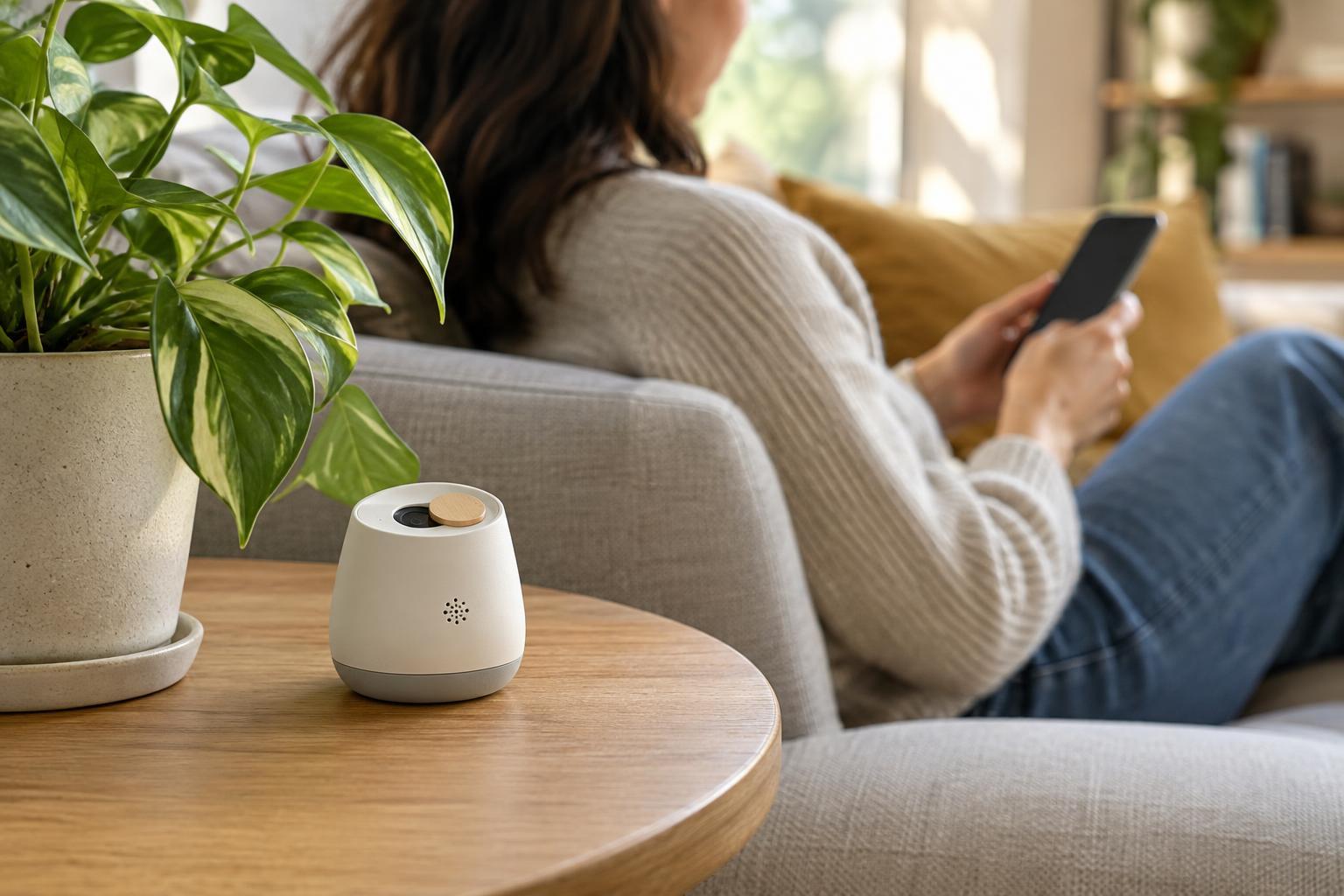
Imagine a smart lamp that adjusts its brightness when someone enters a room. It needs to detect presence, but it may not need to know who entered, store a record of every visit or send that record to a server. Those are separate product choices. Privacy by design means making them deliberately, rather than collecting information first and deciding what to do with it later.
For each feature, a team can ask what outcome the user wants, what information is essential to deliver it and whether a less detailed signal would work. A presence sensor, for example, might provide an occupied-or-empty signal instead of an identifiable activity history. Collecting less can also simplify the product: there is less information to store, explain, protect and eventually delete.
Choose where processing happens
Data does not always have to leave a device to be useful. A camera-equipped doorbell could, depending on its hardware and software, detect motion on the device and send an alert without uploading every moment of footage. A writing app might offer some suggestions locally while using an online service only for features that require it. These approaches involve trade-offs in cost, performance and capability, but the location of processing is a design decision, not a fixed property of the product.
If information must be sent elsewhere, teams can still limit its scope. They can transmit only the detail needed for a particular task, avoid attaching an identity when it is unnecessary and set a clear retention period. They should also consider what happens when a user is offline: a feature that works locally may be more dependable as well as more private. None of these choices makes a product automatically secure, but each reduces the amount of personal information the product handles.
Make choices understandable at the moment they matter
A privacy setting is useful only if people can understand and use it. Asking for access when a feature needs it is often clearer than requesting several permissions during setup. A travel app, for instance, might ask for location when someone requests directions, explain why it needs that access and offer a way to enter a starting point manually. The alternative may be less convenient, but it gives the person a meaningful choice.
Controls also need to match what the product actually does. A label such as “personalize my experience” is vague if it covers several kinds of data collection. More specific options can separate a feature that remembers a preferred route from one that uses trip history for recommendations. If a setting is turned off, the interface should make clear which features change. Good design does not promise that every function will work identically without data; it shows the trade-off honestly.
Design for the full data life cycle
Collection is only the beginning. Product teams also decide how long information remains available, who or what can access it, whether it can be exported and how it is removed. A shared household device makes these questions concrete. One person may set up a voice assistant, while several others use it. A design that offers separate profiles, visible history and straightforward deletion can better reflect that shared setting than a single, hidden account log.
Defaults matter because many people will never visit a settings screen. A sensible starting point is to keep optional collection off, retain data only as long as the feature needs it and make changes reversible where practical. Teams should test these flows as carefully as they test the main feature: can someone find the relevant control, understand its effect and confirm that a deletion request has taken effect? Privacy belongs in prototypes and usability tests, not just in a policy written before launch.
Separate today’s tools from tomorrow’s possibilities
Many of these design methods are already available: limited permissions, on-device processing for suitable tasks, retention controls and interfaces that explain choices in context. Their availability does not mean every product uses them, or that every privacy challenge has an easy technical fix. A small device may have limited processing power, for example, and a service may need some account information to keep settings in sync.
Future products could offer more useful features while relying on less personal data, especially as devices gain processing capability. That is a design goal, not a guarantee. The practical test remains the same whether a team is building a familiar app or exploring a prototype: if a feature needs information about a person, what is the smallest amount that will do the job, and can the person see and control the choice?