Start with the motion a joint allows
A robot joint connects two parts and allows movement between them. The easiest way to picture one is an elbow-like hinge: one part turns relative to another around a single axis. If the joint can bend but cannot slide or twist independently, it has one degree of freedom, often shortened to DOF. A degree of freedom is an independent way something can move.
Not every joint is a hinge. A sliding joint lets a part travel along a straight path, much like a drawer. A rotating joint can turn a link around an axis, while a more complex assembly may combine several independent motions. Engineers count those motions separately. A wrist that can tilt in one direction and rotate around another has two degrees of freedom, even if the motions are packaged into a compact mechanism.
This count describes possible movement, not how far or how well the joint moves. A hinge that turns only through a small angle and one that makes a full revolution can each contribute one degree of freedom. Their ranges of motion are different, and that difference matters when a robot has to reach around an obstacle.
From individual joints to a robot arm
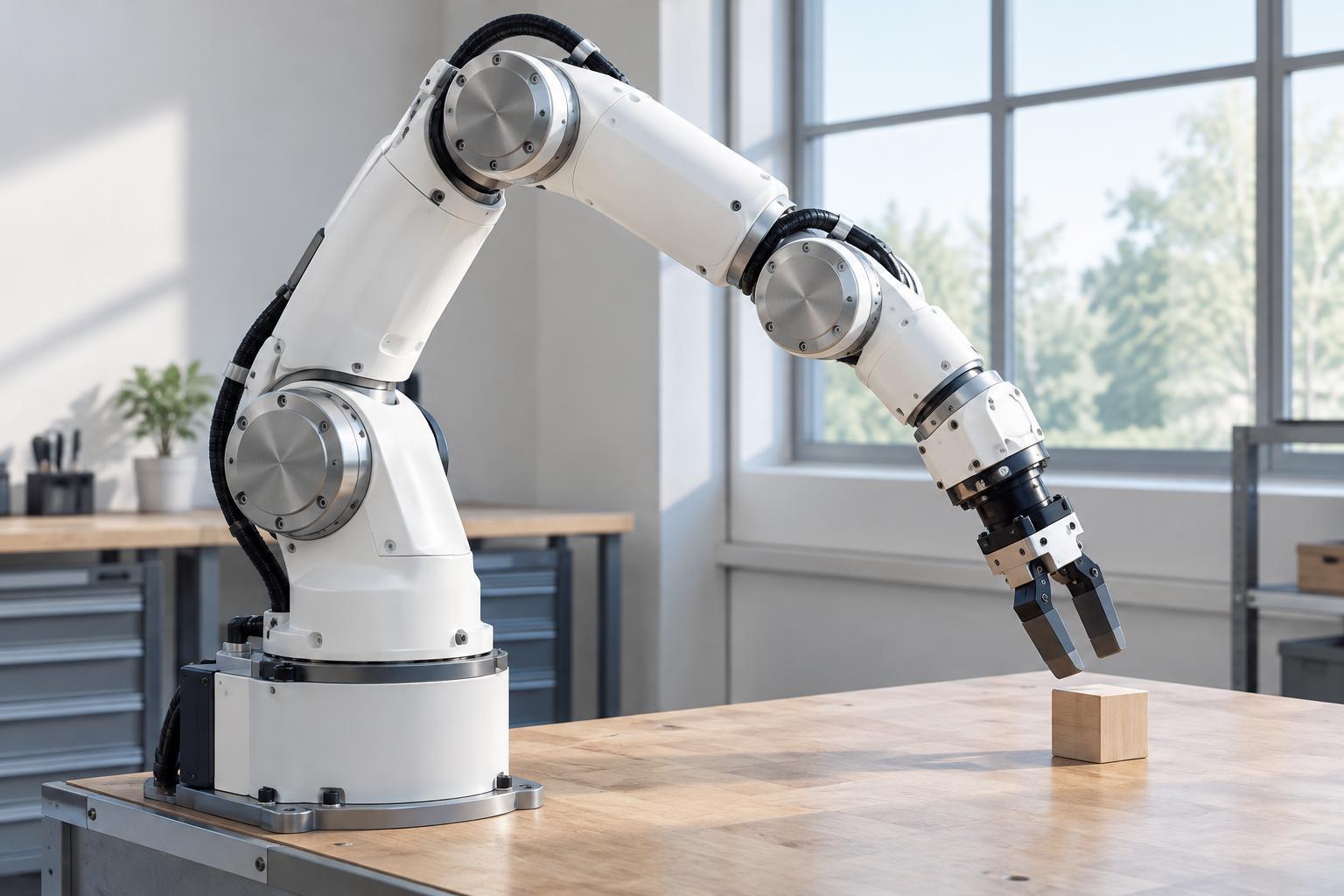
Imagine an arm built from a base that swivels, a shoulder that lifts, an elbow that bends and a wrist that turns. If each movement is independently controlled, the arm has four joint degrees of freedom. Changing one joint alters the position of everything farther along the arm. To put a tool in a particular place, the controller must work out which combination of joint positions will get it there.
Where the tool is located and which way it faces are separate questions. An object moving freely in space has three positional degrees of freedom: movement left or right, forward or back, and up or down. It also has three rotational degrees of freedom, describing its orientation around three axes. Together, these make a six-degree-of-freedom pose. A robot may need to control that full pose to place a tool at a point while holding it at a useful angle.
Six joints do not guarantee that an arm can reach every imaginable pose. Its links have fixed lengths, its joints have limits, and some configurations may put its axes in alignments that restrict useful motion. Conversely, an arm with more than six joint degrees of freedom may have several ways to achieve the same tool pose. That extra flexibility can help it avoid an obstacle or choose a more comfortable configuration, but it also makes motion planning more involved.
Degrees of freedom depend on what you are describing
A wheeled robot shows why the object being counted matters. Its wheels may have several rotating joints, yet the robot itself usually operates on a floor: it changes position across that surface and changes the direction it faces. Wheel motions and whole-robot motion are related, but they are not the same count. A typical car-like vehicle cannot move directly sideways, even though it can eventually reach a spot to its side by steering along a path.
Grippers offer another example. Two fingers might each have moving joints, but a simple gripper controller may give them one shared command: open or close. Count the joints, the independently controlled motions and the movement of the grasped object, and you may get different answers. When someone says a robot has a certain number of degrees of freedom, it is worth asking whether they mean its joints, its tool or its body.
Why movement counts are only a starting point
Degrees of freedom are useful when comparing designs for a task. A factory arm that repeatedly moves parts between fixed points may not need the same flexibility as an arm that must reach into cluttered spaces. A sliding axis can extend a robot's reach along a workbench; an extra wrist rotation can help it turn a tool without repositioning the whole arm. The right arrangement depends on the work, not on having the largest possible number.
Real movement also depends on factors the DOF count leaves out: reach, speed, strength, precision, joint limits and the ability to sense the surroundings. Actuators produce motion, sensors help measure it, and control software coordinates the joints. These are established parts of many working robots. More adaptable robots for changing home or public environments are an active design goal, but a long list of joints alone does not establish that a prototype can handle everyday tasks.
The practical question is therefore not simply, “How many degrees of freedom does it have?” Ask what moves independently, what positions and orientations it can reach, and whether it can perform the intended task reliably. Those questions turn an abstract movement count into a clearer picture of what a robot can do.