What makes a robot soft or rigid?
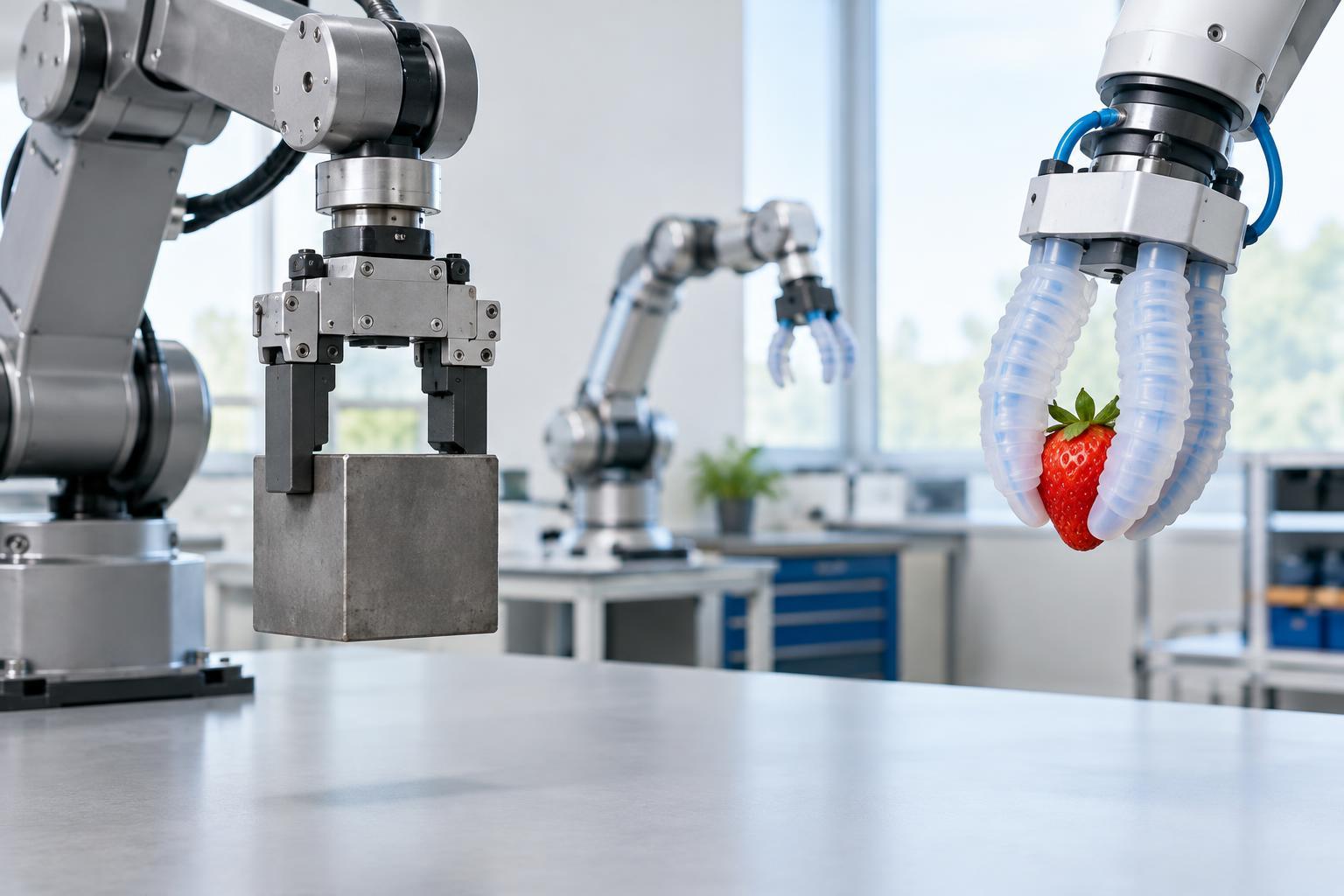
Picture a factory arm placing a metal part into a machine. Its stiff links and joints help it repeat a planned movement. Now picture a flexible gripper curling around a peach. Instead of relying on hard fingers that must meet the fruit at just the right points, it can bend around its shape. Both are robots, but their materials give them different strengths.
Rigid robots generally use firm structures made from materials such as metal and hard plastic. Their parts hold their shape under load, making movement easier to guide precisely. Soft robots use flexible materials, often including elastomers, in parts that bend, stretch or compress. “Soft” describes how a component behaves; it does not mean every part of the machine is flexible. A soft gripper, for example, may still be attached to a conventional rigid arm.
Where rigid structures have the advantage
Stiffness is useful when a robot must carry weight, resist a force or place something accurately. Industrial arms can move tools and components along repeatable paths because their frames do not change shape much during normal operation. Wheels, gears and rigid joints are also practical ways to support and move heavy machines. These are established uses of robotics, not distant possibilities.
That strength comes with design demands. A rigid gripper handling objects of different sizes may need carefully chosen contact points, adjustable fingers or sensors to regulate its grip. If a hard, fast-moving robot shares space with people, its design and operation also need appropriate safety measures. Rigid does not mean unsafe by default, just as precise movement does not remove every risk.
What flexibility makes possible
A flexible gripper can conform to an object rather than forcing the object to fit a fixed opening. That can be helpful for irregular produce, fragile items or objects whose exact position varies. Soft components can also squeeze through a tight space or make contact over a wider area. These qualities make soft robotics a useful approach when a task calls for adaptable contact rather than maximum force.
Flexibility introduces its own difficulties. A soft finger changes shape as it moves, so it can be harder to predict and measure its exact position than that of a stiff link. Some designs use air pressure or fluid pressure to bend; others use cables or different actuators. Each approach needs a way to control motion and may require pumps, tubing or other supporting hardware. Soft materials can also wear, tear or behave differently as conditions change. Whether they are the better choice depends on the task, not simply on how gentle they look.
Why many useful designs are hybrids
The choice is rarely between a completely soft robot and a completely rigid one. A warehouse or factory system might use a sturdy arm for reach and a compliant gripper for contact with an item. The arm supplies structure and positioning; the gripper tolerates some variation in the item’s shape or placement. This division of work can be more practical than asking one material to do everything.
A familiar comparison is a human hand holding a tool. Bones provide a firm framework, while softer tissues help the fingers make contact. Robots do not need to copy a hand to benefit from the same broad principle: use stiffness where a load needs support and flexibility where contact needs to adapt. Designers can also add sensors or control rules to either kind of structure. Materials matter, but they are only one part of the system.
How to judge a robot for a real task
Start with the object and the environment. Is the robot moving a heavy part to a precise location, or picking up objects that vary in size and shape? Must it work quickly, fit into a narrow space or touch something easily damaged? Then consider what happens after thousands of cycles: a design that grips well in a demonstration also needs to be maintained and used reliably in its intended setting.
Rigid industrial robots and flexible grippers already have practical applications. More ambitious soft robots that move through confined spaces or take on new body shapes are also being explored, but a promising prototype is not the same as a widely deployed tool. The clearest way to understand any proposed robot is to ask what its materials help it do, what they make harder and what other components it needs to complete the job.