A warning beyond the windshield
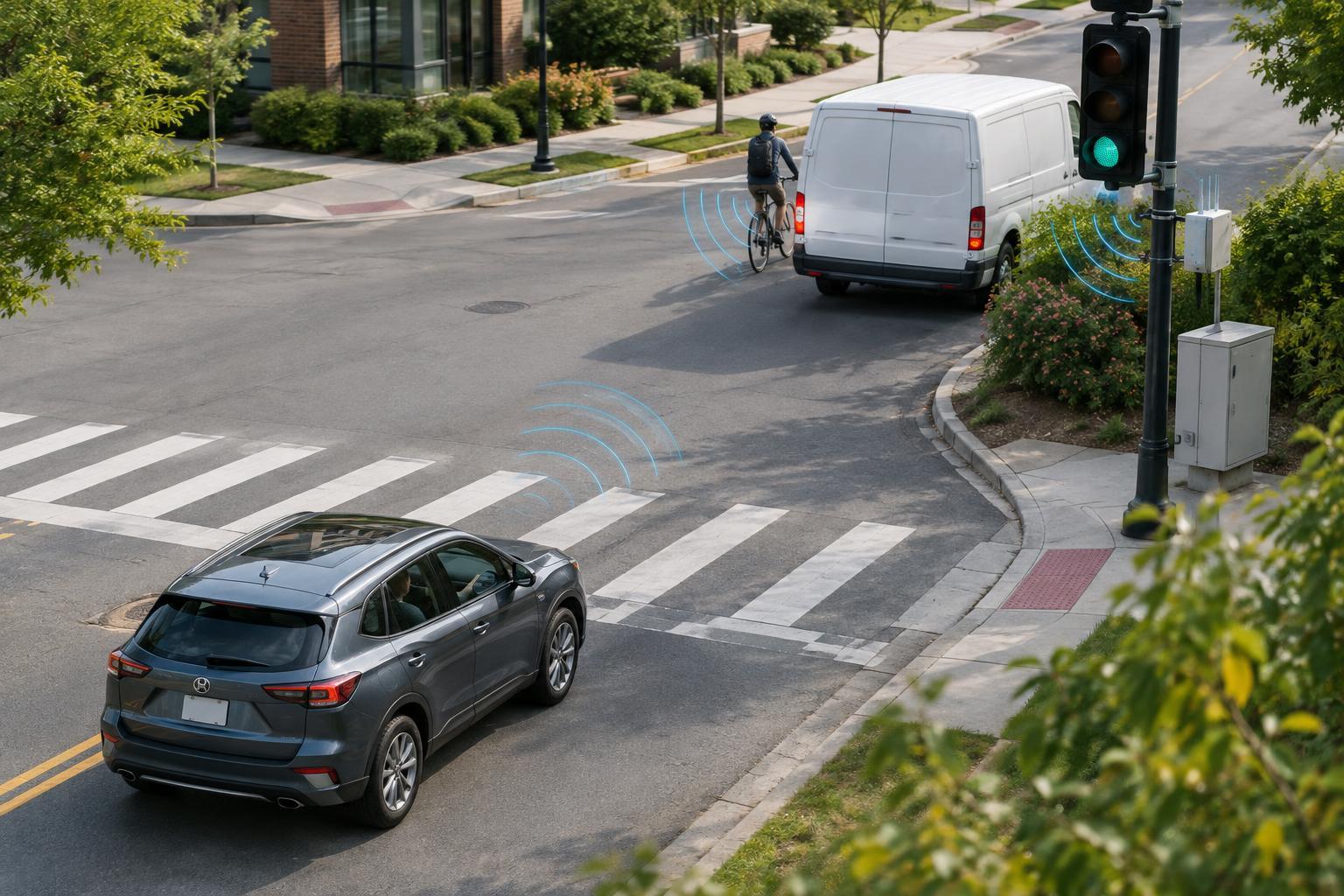
Imagine approaching an intersection where a large van blocks your view of a cyclist. Your eyes and the car’s cameras cannot see around it. Vehicle-to-everything communication, usually shortened to V2X, is an approach that could add another source of information: a message from a nearby vehicle, a roadside device or a compatible device carried by the cyclist. The vehicle might then warn you before the cyclist becomes visible.
That example shows V2X’s potential, not a guarantee. The message would need to arrive in time, contain useful position information and be interpreted correctly. The driver would still have to watch the road and respond to what is actually happening. V2X is best understood as a possible extra layer of awareness, rather than a substitute for sight, sensors or judgment.
What vehicles would be talking to
The “everything” in V2X covers several kinds of connection. Vehicle-to-vehicle communication could share information such as location, direction and braking activity. Vehicle-to-infrastructure communication could bring alerts from equipped traffic signals, crossings or work zones. Vehicle-to-pedestrian communication could involve a compatible phone or other device carried by someone walking or cycling. These connections may use different technical approaches, and not every vehicle or road feature supports them.
A safety message does not have to tell a car what to do. It might simply report that a vehicle ahead is braking hard or that a traffic signal is about to change. The receiving vehicle could compare that message with its own sensors and decide whether to show a warning. In some designs, the information might also support a driver-assistance feature. The distinction matters: sharing information is one task; interpreting it safely in a busy street is another.
Where an early alert could matter
V2X could be especially useful when a hazard is hidden or difficult to spot quickly. Consider traffic slowing around a bend, an emergency vehicle approaching an intersection, or a road crew working just beyond a rise. A timely alert could give a driver more time to look, slow down or leave space. Unlike a camera, a radio message does not necessarily need a clear line of sight to the hazard, although buildings, interference and equipment design can still affect communication.
Intersections offer another practical example. An equipped traffic signal could share its status with approaching vehicles, while vehicles could share their movements with one another. That information might help identify a potential conflict before it becomes obvious from the driver’s seat. It would not make an intersection collision-proof: messages can be missing or inaccurate, road users may change course, and warnings delivered too often may be ignored.
Some V2X functions and trials already exist, but their usefulness on any particular trip depends on compatible equipment and local deployment. A scenario in which every car, cyclist, signal and work zone communicates seamlessly remains a future possibility, not a description of ordinary roads today.
Why a useful warning is hard to deliver
Coverage is a central challenge. If only some vehicles can send messages, a quiet V2X system does not mean the road is clear. The same applies to people on foot: no one should need to carry a compatible device to be noticed or protected. Vehicles must continue to rely on the driver and other available sensing methods, especially for road users who do not transmit anything.
Messages also need to be timely, trustworthy and easy to understand. A delayed braking alert may be useless; an incorrect location could point attention in the wrong direction. Systems must be designed to resist misleading messages and manage information about people’s movements responsibly. Even a technically correct warning can be distracting if it appears at the wrong moment or demands too much interpretation.
Compatibility matters, too. For V2X to work across different brands and road operators, devices need ways to exchange and understand relevant messages. Roadside equipment must also be installed and maintained. These are practical deployment questions, not just problems that can be solved by adding a wireless chip to a car.
A sensible role for V2X
The strongest case for V2X is modest but valuable: it could tell a driver or vehicle about a relevant hazard a little earlier than sight or onboard sensors alone would allow. That extra time may help, particularly where a bend, parked vehicle or large truck blocks the view. Its benefit will depend on the quality of the message, the equipment nearby and how clearly the alert is presented.
Road safety will still rely on visible crossings, sensible speeds, attentive drivers and vehicles that can respond to the world around them. V2X could complement those basics as compatible systems spread. The useful question is not whether roads will become fully connected, but where a well-timed, reliable warning can give someone a better chance to avoid a mistake.