A useful definition of a robot
Imagine a floor-cleaning machine moving through a room. It detects a chair leg, changes direction and continues cleaning. That combination of sensing, decision-making and physical action is a useful way to recognize a robot. Its sensors gather information about the room, its controller decides what to do next, and its motors carry out the decision.
Not every moving machine is a robot. A basic fan turns its blades when switched on, but it does not need to observe its surroundings to choose where to go. A remote-controlled toy car can be called a robot in some contexts, although its human operator makes most of the decisions. There is no single everyday definition that settles every borderline case. What matters is understanding which tasks a machine performs for itself and which remain under human control.
Sensors: how a robot notices the world
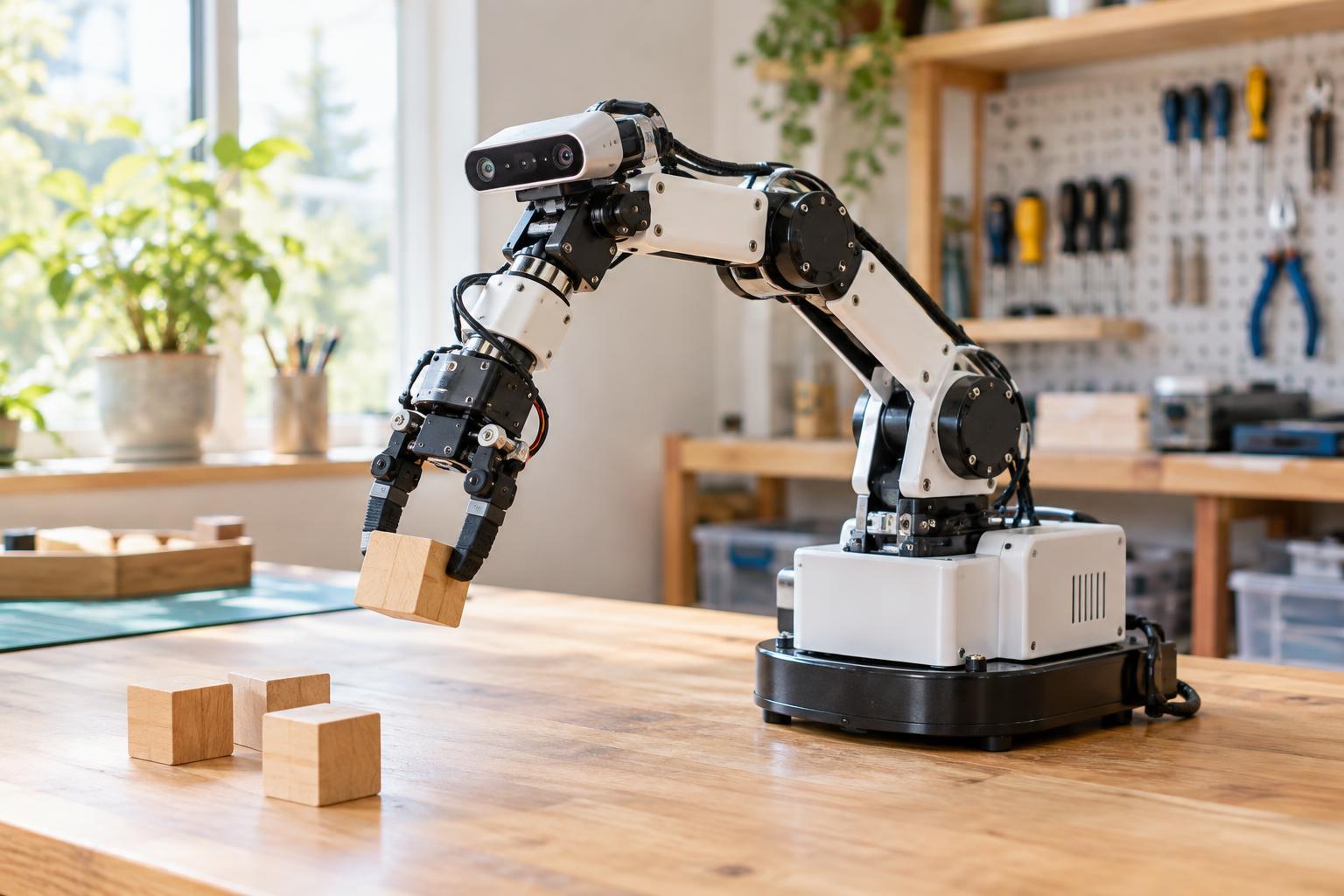
Sensors convert some property of the environment or the machine into information a controller can use. A cleaning robot might use contact sensors to register a bump and distance sensors to detect an obstacle before touching it. Sensors inside its wheels can help estimate how far it has traveled. An industrial arm may use joint-position sensors to check where its links are, while a gripper may use a force sensor to help avoid squeezing an object too hard.
A sensor reading is not the same as complete understanding. A distance sensor might report that something is nearby without identifying what it is. A camera can capture an image, but software must interpret it, and lighting or an obstructed view can make that difficult. Robots often combine several kinds of readings because each has limits. Even then, a robot's picture of its surroundings can be incomplete.
Actuators: how a robot does something
Actuators turn the controller's commands into physical changes. Electric motors can spin wheels, move an arm or rotate a camera. Other actuators may open a gripper, extend a mechanism or control the flow of air or fluid. The choice depends on the job: a small mobile robot needs a way to travel, while a sorting arm needs a way to position and release objects.
Actuators also reveal why robotics is more than software. A program may choose the right action, but the machine still needs enough grip, range of motion and power to perform it. A wheel can slip on a smooth floor. A gripper designed for rigid boxes may struggle with soft or irregular items. Those physical constraints shape what a robot can do reliably.
Controllers: connecting information to action
The controller is the part that processes inputs and sends commands to actuators. It may be a small computer running simple rules or a system running more complex software. In a basic obstacle-avoidance routine, the controller reads a distance sensor, slows the wheels when an object is close, turns, and then checks the sensor again. This repeated cycle of sensing and adjustment is called feedback.
Feedback helps a robot respond when the physical world does not behave exactly as expected. An arm's controller can compare its intended position with a joint sensor's reading and adjust the motor command. But feedback does not guarantee a good result: a faulty sensor or an unsuitable rule can still lead to a mistake. Many robots therefore have limits on speed, force or operating area, as well as ways for people to stop them.
Where the boundary gets blurry
A washing machine senses conditions, follows a programmed sequence and spins a drum. It has components similar to those in a robot, yet people usually call it an appliance because it performs a narrow task in a fixed setting. A programmable industrial arm is more readily called a robot: it can be directed through different movements to handle different workpieces. A mobile robot adds the challenge of navigating an environment that may change around it.
Robots do not have to look human, and they do not have to be fully autonomous. Some carry out a sequence programmed by a person; others make limited choices from sensor readings; still others are guided directly by an operator. These arrangements are established technology. More ambitious machines intended to handle a wide variety of unfamiliar household tasks are a different proposition: they may be demonstrated as prototypes, but handling unpredictable objects and spaces reliably remains difficult.
When you encounter a machine described as a robot, ask three questions: What can it sense? What can it physically change? What decisions does its controller make without a person intervening? The answers explain more about its capabilities than its shape—or its name—ever could.