A way for robot software to work together
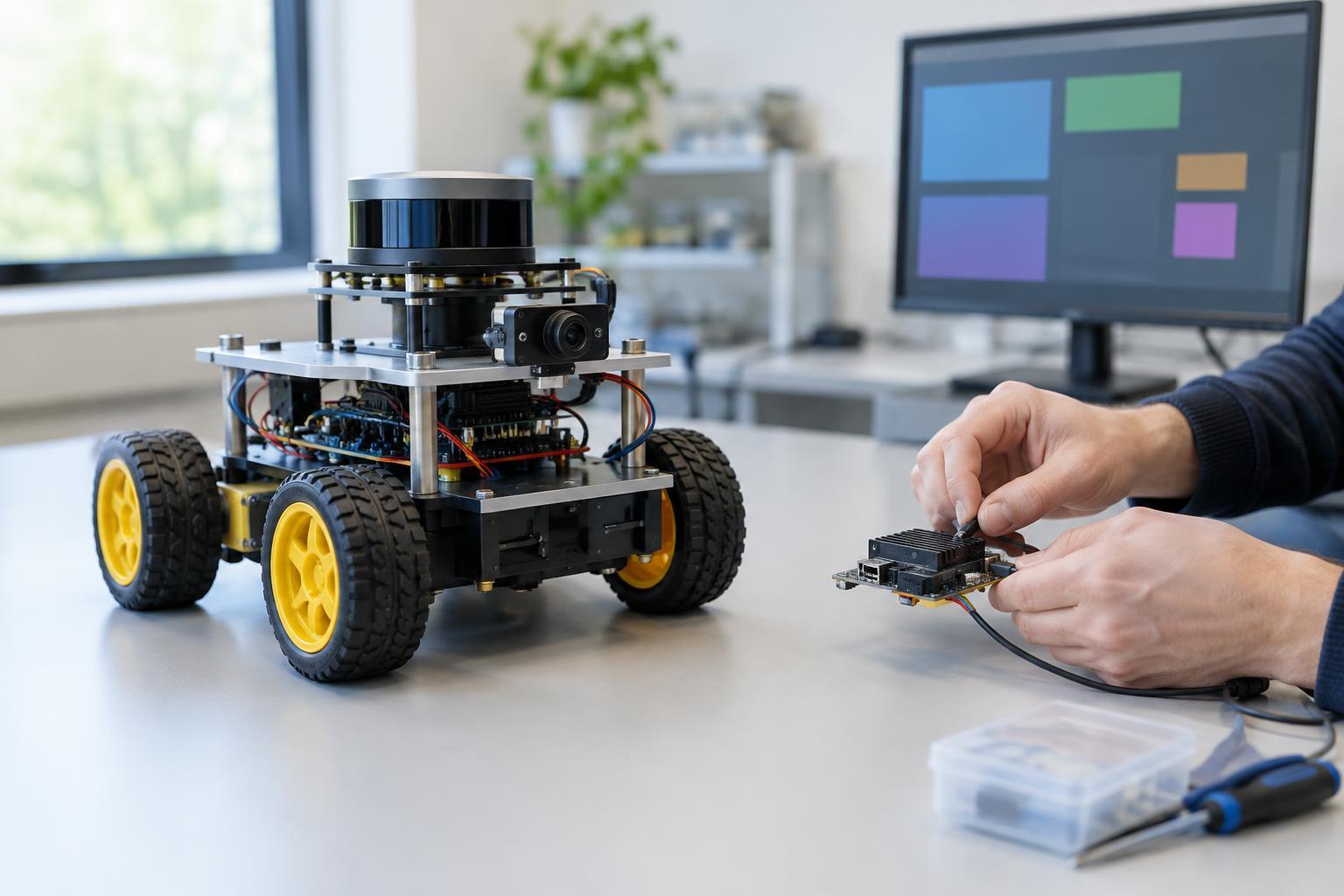
Imagine a small robot that moves through a building. Its camera produces images, its wheels report their speed, and a navigation program decides where to go next. Those jobs may run in separate programs, possibly on different computers inside the robot. They need a reliable way to share information without every program having to be built as one large piece of software.
ROS 2, short for Robot Operating System 2, provides a framework for organizing that work. Despite its name, it is not an operating system in the same sense as the software that manages a computer’s hardware. It sits alongside an operating system and supplies tools, conventions and communication mechanisms for building robot applications. A robot does not need ROS 2 to function, but developers may choose it to make complex software easier to assemble and change.
Nodes, messages and different kinds of conversations
A ROS 2 application is commonly divided into nodes: programs or program components with particular responsibilities. One node might read a laser scanner; another might estimate the robot’s position; a third might send movement commands. Nodes can exchange data on topics. A scanner node, for example, publishes measurements, while any node that needs those measurements can subscribe. The scanner does not have to know every subscriber in advance.
Not every exchange is a continuous stream. A service supports a request and a response, such as asking a component for a setting. An action suits a longer task that may report progress or be canceled, such as telling a robot to travel to a destination. ROS 2 also offers ways to manage settings and start related components together. These patterns help developers keep responsibilities separate while making the whole machine cooperate.
ROS 2 uses underlying communication software to move messages between components. Developers can adjust some delivery behaviors to suit different needs: a brief sensor update, for instance, may call for a different approach than a command that must not be overlooked. Those choices matter, but they are engineering decisions, not automatic guarantees that every message will arrive at exactly the right moment.
What a mobile robot still has to learn
Connecting components is not the same as giving a robot useful abilities. ROS 2 does not, by itself, recognize a doorway, decide whether a route is clear or understand that a person is about to step in front of it. Developers must choose or build software for perception, mapping, planning and control, then make sure those components work with the robot’s sensors and motors. The wider ROS 2 ecosystem includes packages for some of these tasks, but a package still needs configuration and testing for a particular machine and setting.
Consider a robot asked to carry an item across a room. ROS 2 can help pass camera images to a perception component, a destination to a navigation component and speed commands to a motor interface. It does not guarantee that the camera sees a low obstacle, that the map matches the room or that the wheels respond as expected. Those outcomes depend on the hardware, the algorithms and the quality of their integration.
The limits that matter outside a demo
A robot operating near people needs more than software that can send messages. Its designers must consider physical safeguards, failure behavior, testing and the conditions in which it will operate. Using ROS 2 does not make a machine safe or certify it for a particular use. Nor does it automatically provide the precise timing that a demanding control task may require; timing depends on the complete hardware and software setup.
ROS 2 can support security features for communication, but those features must be configured as part of a broader security design. Similarly, a robot needs appropriate drivers or interfaces to communicate with its specific sensors and actuators. If a component fails or a network connection drops, developers must decide how the system should respond rather than assume the framework will make the right physical decision for them.
Why the distinction is useful
ROS 2 is established as a development framework, while any particular robot’s capabilities must be judged on their own evidence. A prototype that navigates a prepared room has demonstrated something narrower than a machine that can handle unfamiliar, crowded spaces. Treating the framework as the robot’s intelligence can obscure that difference.
A useful way to think about ROS 2 is as shared infrastructure for a team of software components. It gives those components practical ways to communicate and gives developers a structure for improving them. What the robot can actually do still comes from the components, hardware and testing built around that structure.