Start with the route, not the robot
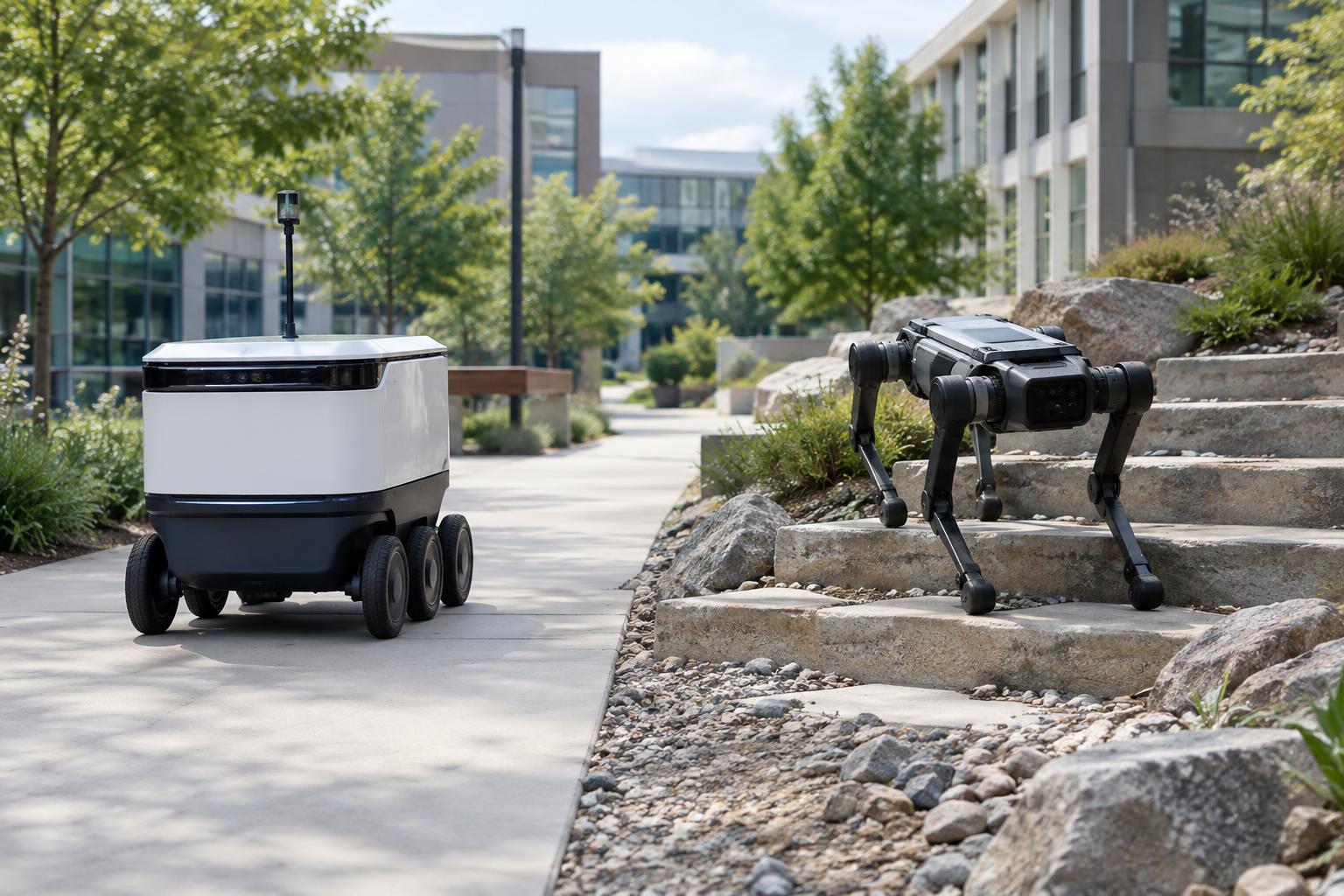
Picture a robot carrying supplies down a smooth hospital corridor. Wheels are a natural choice: the floor is firm, the route is relatively predictable, and the robot can roll without repeatedly lifting its weight. Now picture a robot crossing a rocky path with steps and gaps. Legs become more appealing because they can place each foot on a suitable patch of ground rather than requiring a continuous surface beneath the machine.
That contrast does not mean wheels belong indoors and legs belong outdoors. A wheeled robot can travel outside on pavement or firm paths, while a legged robot may be useful inside a building with stairs. The deciding question is whether the robot can complete its specific route and task consistently, safely and with a practical amount of energy.
Why wheels work so well on prepared surfaces
On flat, firm ground, rolling is generally an efficient way to move. A wheeled robot can carry its load while its motors turn the wheels, without having to coordinate a sequence of lifting and placing feet. Wheels and their controls can also be comparatively straightforward to design and maintain. These advantages help explain their use in settings such as warehouses, factories and indoor delivery systems.
Wheeled designs still vary. Larger wheels may clear small obstacles that stop tiny ones. Different steering arrangements can help a robot turn in a narrow aisle or position itself beside a shelf. Tires, suspension and ground clearance matter when the surface becomes uneven. But every wheeled design has limits: a curb, deep rut or staircase may interrupt its route even if most of the journey is easy.
One practical alternative is to change the environment instead of the robot. A ramp, smoother threshold or clearly maintained pathway can make a simple wheeled machine more useful. In a setting where people also move carts or use mobility aids, those improvements may serve more than the robot.
What legs can do—and what they cost
Legs offer a different kind of mobility. A legged robot can, in principle, step over an obstacle, place its feet on separated footholds or adjust its posture on uneven ground. That makes legged designs attractive for tasks such as inspecting equipment around stairs or moving through places where building a smooth route would be impractical.
Those capabilities come with trade-offs. Walking requires coordinated joints, sensors and control software. The robot must manage balance while deciding where to put its feet, and a misstep can matter when it is carrying equipment or working near people. More moving parts can also mean more potential maintenance points. Depending on the design and task, a legged robot may use more energy than a wheeled one covering the same distance on a level floor.
Legged robots can already demonstrate useful movement in controlled tasks, but an impressive demonstration is not the same as dependable performance on every route. Loose ground, slippery surfaces, unexpected obstacles and limited battery capacity can all affect what a particular machine can do.
The best design may use both
Some robots combine wheels and legs to avoid treating the choice as all-or-nothing. A machine might roll along a corridor, then use articulated limbs to climb a step or adjust its height. Other designs put wheels at the ends of legs, allowing the robot to change its stance while retaining efficient rolling where the ground permits.
A hybrid design does not automatically outperform a simpler robot. It adds components, control decisions, weight and potential failure points. Its value depends on the route: if a robot encounters one short staircase during an otherwise smooth trip, a ramp or lift may be a more practical solution than giving the robot legs. If the environment cannot be modified and obstacles are common, extra mobility may justify the complexity.
Match the machine to the whole job
Terrain is only the first test. A useful comparison also asks what the robot must carry, how far it must travel, how often it can recharge and who shares the space. A low, wheeled robot might move goods efficiently through a mapped building but struggle with a single raised doorway. A legged inspection robot might reach equipment beyond stairs but have less capacity for long trips or heavy loads.
For an everyday buyer or operator, the most revealing question is not “Can it walk?” or “How fast can it roll?” It is “Can it finish this route repeatedly with the required load and reasonable upkeep?” Established wheeled systems often make sense where routes are prepared and repeatable. Legged and hybrid machines are promising where surfaces are irregular or access is difficult, but each proposed use needs testing in the environment where it will actually work. The future may include all three approaches—not one winning shape, but better matches between machines and the places they serve.