A rehearsal space for physical machines
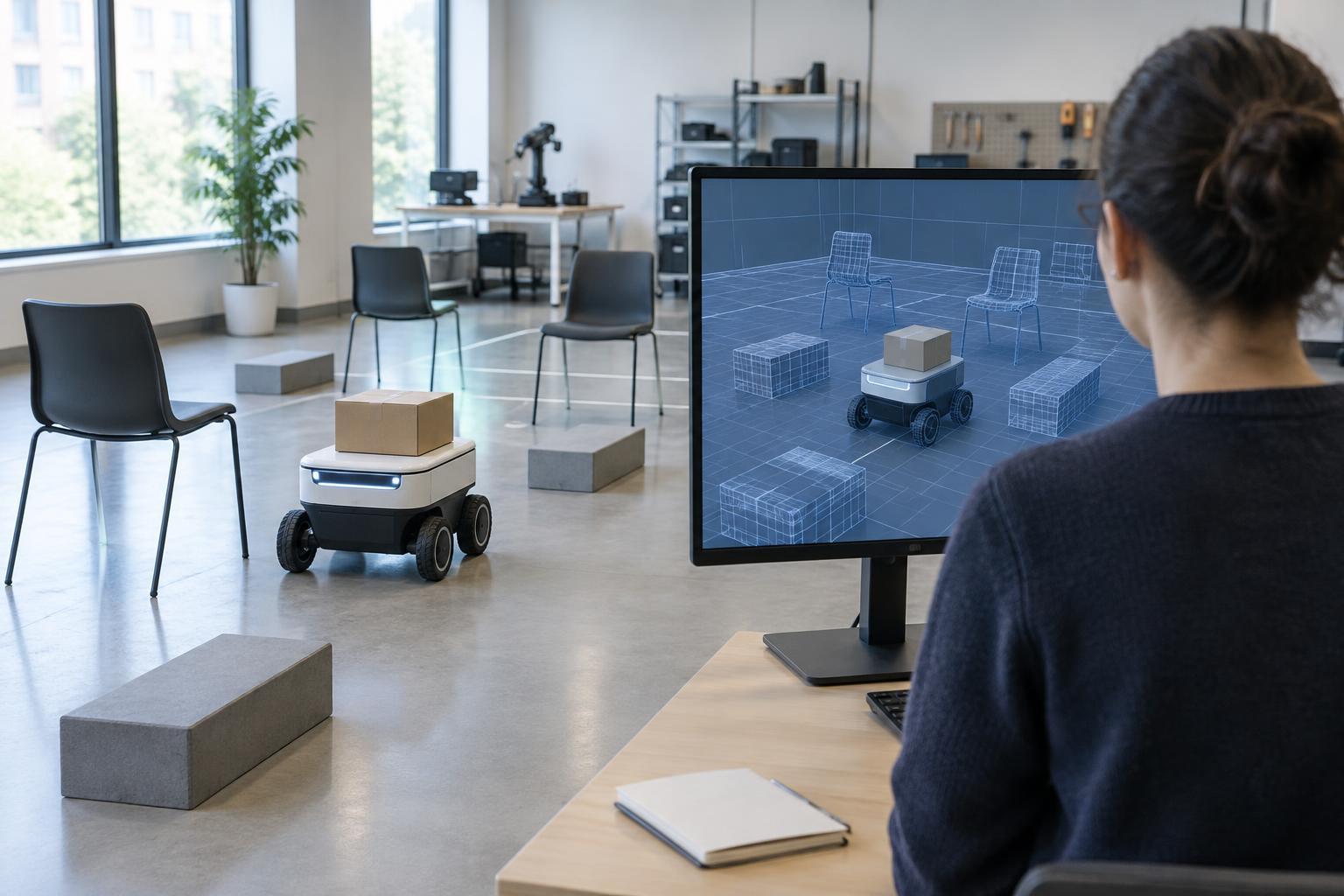
A robot needs more than a set of instructions. It must sense its surroundings, choose an action and move through a world where objects can slip, people can change direction and floors may be uneven. Testing every new behavior directly on a physical machine can be slow and sometimes risky. Simulation gives developers a virtual place to try an idea before asking a robot to carry it out.
Imagine a warehouse robot learning to approach a shelf. In a simulation, developers can place shelves at different angles, move boxes into its path and check whether it stops when a person appears. They can repeat the same situation after changing the robot’s software, making it easier to see whether the change helped. This does not prove the robot is ready for a warehouse, but it can reveal obvious problems before a real trial begins.
What a robot simulation actually models
A simulation represents some combination of the robot, its surroundings and the rules that govern movement. A virtual robot may have wheels, joints or a gripper that correspond to its physical parts. The software can estimate how those parts respond to commands, while a virtual camera or distance sensor supplies information for the robot’s control system to interpret.
How detailed the model needs to be depends on the task. A delivery robot practicing routes may need a useful model of corridors, obstacles and turning space. A robotic hand picking up a cup may need a closer approximation of contact, friction and grip. More detail is not automatically better: a complex model takes effort to build, and it can still get an important physical property wrong.
Simulation is also useful when a task has many possible starting conditions. Developers can vary an object’s position, change the lighting or add an obstacle to see how the robot responds. These variations help expose software that works only when everything is arranged just so.
Why virtual practice is useful
Some mistakes are cheaper to discover on a screen. If a proposed movement causes a virtual arm to collide with a table, developers can revise it without damaging a machine or the table. They can also compare different designs before building every option. For example, a team might check whether a robot arm can reach all the intended positions from a planned mounting point.
Virtual tests can make unusual situations easier to examine. A robot that usually travels through clear hallways should still have a sensible response when its route is blocked. In simulation, developers can create that blockage repeatedly and observe what the robot tries to do. The results can guide changes to its software and identify situations that deserve careful physical testing.
Simulation can also help train certain robot control systems by letting them practice many attempts without tying up a physical robot for every attempt. That is a possible use, not a guarantee: useful practice depends on whether the simulated task resembles the one the real machine will face.
The gap between a simulated robot and a real one
A virtual floor may be perfectly level, while a real floor has seams, dust or patches with different grip. A simulated camera may produce a clean image, while a physical camera sees glare, shadows or a partly covered lens. Motors, batteries and sensors can also behave differently from their models. These mismatches are often called the simulation-to-reality gap.
One way to prepare for that gap is to vary conditions during virtual tests rather than relying on a single ideal scene. Developers might change surface grip, object weight or sensor readings within reasonable ranges. A robot that succeeds across varied conditions may be less dependent on one precise model. Even so, virtual variety cannot anticipate every surprise.
Physical trials therefore remain necessary. Teams can begin with controlled tests, observe where the real robot differs from the model and update their simulation accordingly. The process is a loop: simulate, test, compare and revise.
From promising prototype to dependable behavior
Passing a simulation means a robot handled the situations represented there. It does not mean the robot will behave reliably in every home, workplace or public space. A household robot, for instance, may encounter furniture arrangements, loose cables and fragile objects that were missing from its virtual rooms. A test should be understood in terms of what it covered—and what it did not.
The strongest approach treats simulation as one stage of development. Virtual testing helps teams find problems early and plan more focused real-world trials. Physical testing shows how the machine actually behaves. Together, they offer a more useful picture than either could alone: simulation makes exploration easier, while real-world experience keeps expectations grounded.